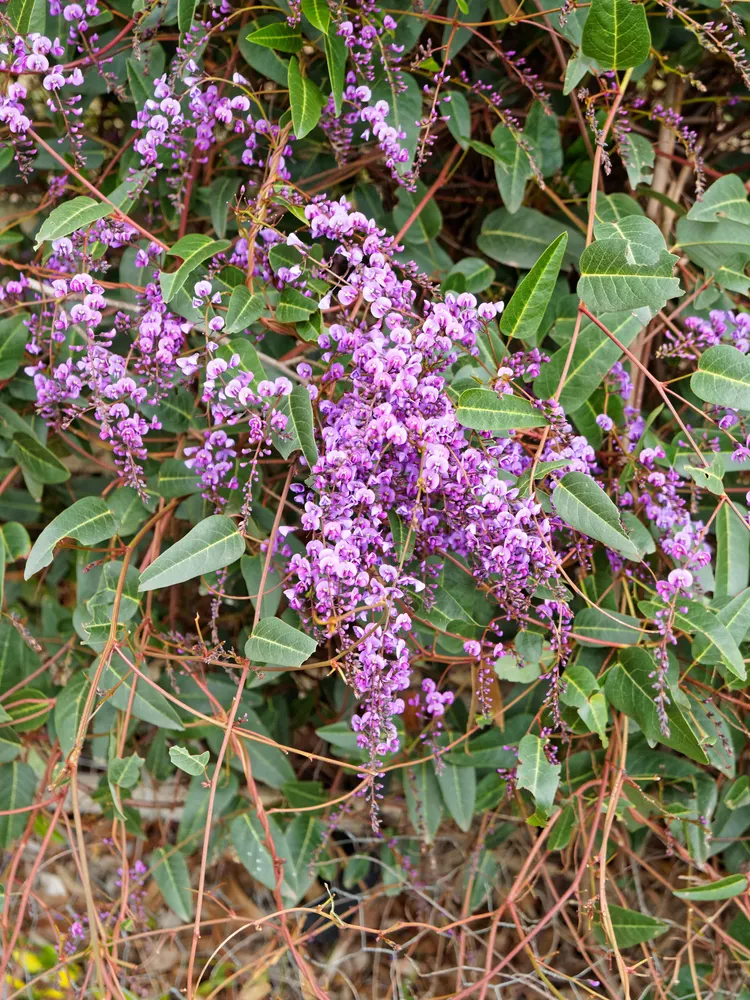
Photo: Groogle, CC BY-SA 4.0 (via Wikimedia Commons)
Purple Coral Pea
Hardenbergia violacea
Also known as Happy Wanderer, False Sarsaparilla, Native Sarsaparilla, Native Lilac, Vine Lilac
Key benefits
✦Traditional uses
✦Long before it became a nursery favorite, Purple Coral Pea scrambled quietly through the dry forests of eastern Australia, its curtains of violet flowers signaling the end of winter. Early European settlers, missing the comforts of home, took to calling it false sarsaparilla and steeped the leaves as a homemade tea when true sarsaparilla was scarce on the frontier, a humble bush substitute rather than a medicine chest staple. Its greater legacy has always been in the garden rather than the teacup, prized as a tough, undemanding vine that could soften a fence line or hold a bare slope where little else would take.
How to grow & use it
✦The full apothecary for Purple Coral Pea
Traditional remedies and step-by-step preparations, a complete growing guide, and how to harvest, dry, and store it, all unlocked with HerbLens Unlimited.
- ✦Remedies & preparations
- ✦ Growing guide
- ✦Harvest & storage
From under $6 a month. Free plant identifications always included.
- ✦Kangaroo paw
- ✦Grevillea
- ✦Native correa
- ✦True sarsaparilla (Smilax species) for anyone seeking the flavor the settlers were chasing
“For the fence line that needs softening and the slope that needs holding, in a wash of violet.”
The widely sold cultivar called 'Happy Wanderer' is one of the most popular native climbers in Australian gardens, prized simply for how effortlessly it turns a bare fence into a wall of purple every spring.
No reliable food use beyond an informal historical leaf tea; the seeds and pods are not established as edible and should not be eaten, especially by children or pets.