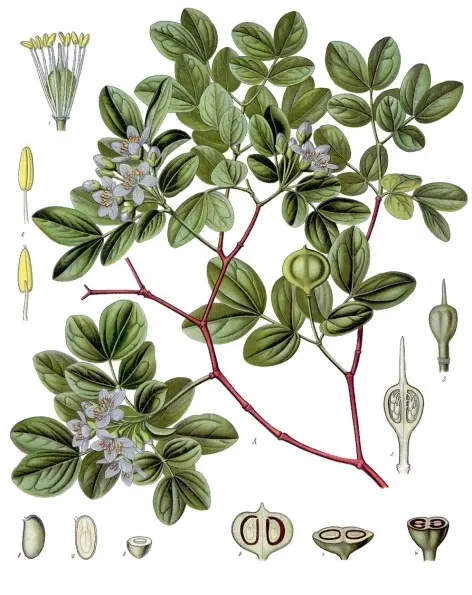
Photo: Franz Eugen Köhler, Köhler's Medizinal-Pflanzen, Public domain (via Wikimedia Commons)
Lignum Vitae
Guaiacum officinale
Also known as Tree of Life, Guaiacwood, Pockwood, Holywood
Key benefits
✦Traditional uses
✦When Spanish ships returned from the Caribbean in the early 1500s, they carried back a wood so dense it sank in water, and word of it spread through European apothecaries as a wonder cure. The Taino and other Caribbean peoples had long relied on the tree's resin and bark for joint pain and skin troubles, and European physicians adopted it eagerly, calling it 'holy wood' and prescribing it widely for arthritis, gout, and stiffness of the limbs. For centuries afterward, guaiac resin remained a staple of the traveling apothecary's chest, valued as a warming remedy that was thought to work its way through the whole body. Its name, drawn from the tree's old reputation as a cure-all, still echoes today in guaifenesin, the common cough medicine derived from one of its resin compounds.
How to grow & use it
✦The full apothecary for Lignum Vitae
Traditional remedies and step-by-step preparations, a complete growing guide, and how to harvest, dry, and store it, all unlocked with HerbLens Unlimited.
- ✦Remedies & preparations
- ✦ Growing guide
- ✦Harvest & storage
From under $6 a month. Free plant identifications always included.
- ✦Willow bark
- ✦Devil's claw
- ✦Black cohosh
- ✦Devil's claw
- ✦Turmeric
“When old, aching joints call for the densest, most storied wood in the apothecary's chest.”
The resin compound guaiacol, first isolated from lignum vitae, gave its name to guaifenesin, the expectorant found in many modern over-the-counter cough syrups.
Guaiac resin can cause stomach upset in excess, so traditional use favors small, occasional amounts, and it should be avoided during pregnancy and breastfeeding or alongside blood-thinning medication. The tree is critically overharvested and CITES-protected, so resin or wood should come only from a sustainably sourced supplier.