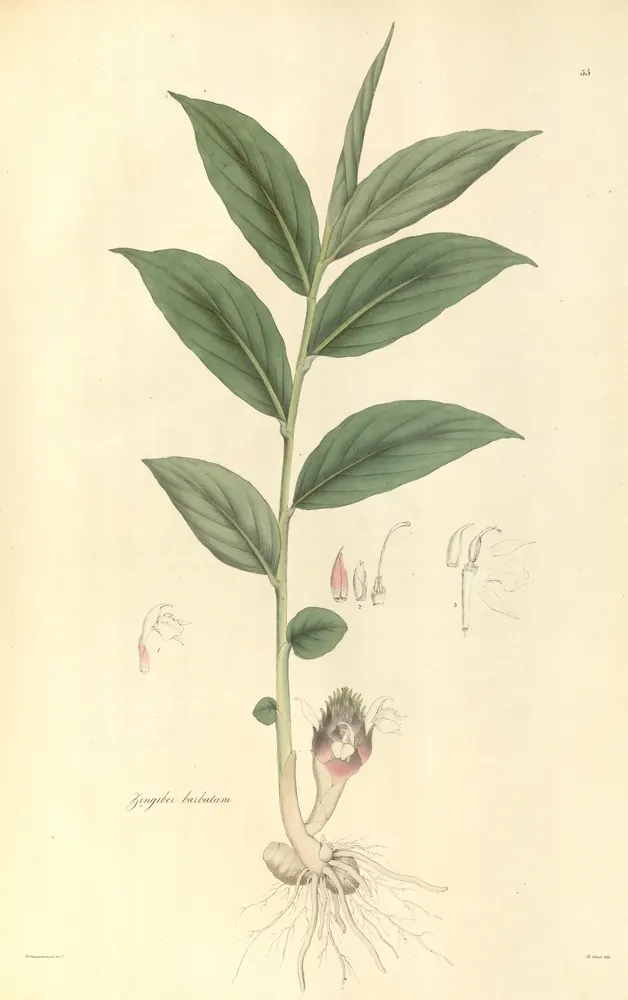
Photo: "Image courtesy Missouri Botanical Garden. http://www.botanicus.org"., CC BY 3.0 (via Wikimedia Commons)
Bearded Wild Ginger
Zingiber barbatum
Also known as Meik tha-lin (Burmese), Wild Medicinal Ginger, Forest Ginger
Key benefits
✦Traditional uses
✦Zingiber barbatum was first described in 1830 by the botanist Nathaniel Wallich, who found it growing wild on the hills above the Irrawaddy River near Prome in what is now Myanmar. Long before that formal description, local healers already knew its knotted rhizome, and it has been used for generations in Myanmar's indigenous medicine for aches, swelling, and fever in much the same spirit that common ginger is used across Asia. Because it grows scattered through forest understory rather than in cultivated fields, it never became a market crop the way its cousin Zingiber officinale did, and it remains what botanists call an underutilized species, familiar to villages near its forests but almost unknown outside them. Recent laboratory work on mice has begun to bear out the old uses, finding real anti-inflammatory, pain-relieving, and fever-reducing activity in extracts of the rhizome.
How to grow & use it
✦The full apothecary for Bearded Wild Ginger
Traditional remedies and step-by-step preparations, a complete growing guide, and how to harvest, dry, and store it, all unlocked with HerbLens Unlimited.
- ✦Remedies & preparations
- ✦ Growing guide
- ✦Harvest & storage
From under $6 a month. Free plant identifications always included.
- ✦Turmeric
- ✦Lemongrass
- ✦Holy basil
- ✦Common ginger (Zingiber officinale)
- ✦Galangal
“For the deep ache after a long day, the old remedy the forest villages never stopped reaching for.”
Zingiber barbatum takes its name from the Latin barbatus, meaning bearded, a nod to the fringed, whisker-like edge of its flower's lip, a detail botanists only described in careful detail nearly two centuries after Wallich first found the plant on the banks of the Irrawaddy.
Like other wild gingers, the rhizome may cause heartburn if taken in excess and can intensify the effect of blood-thinning medication. Only gather it from a positively identified plant, since it resembles other forest gingers, and its safety in pregnancy hasn't been established.