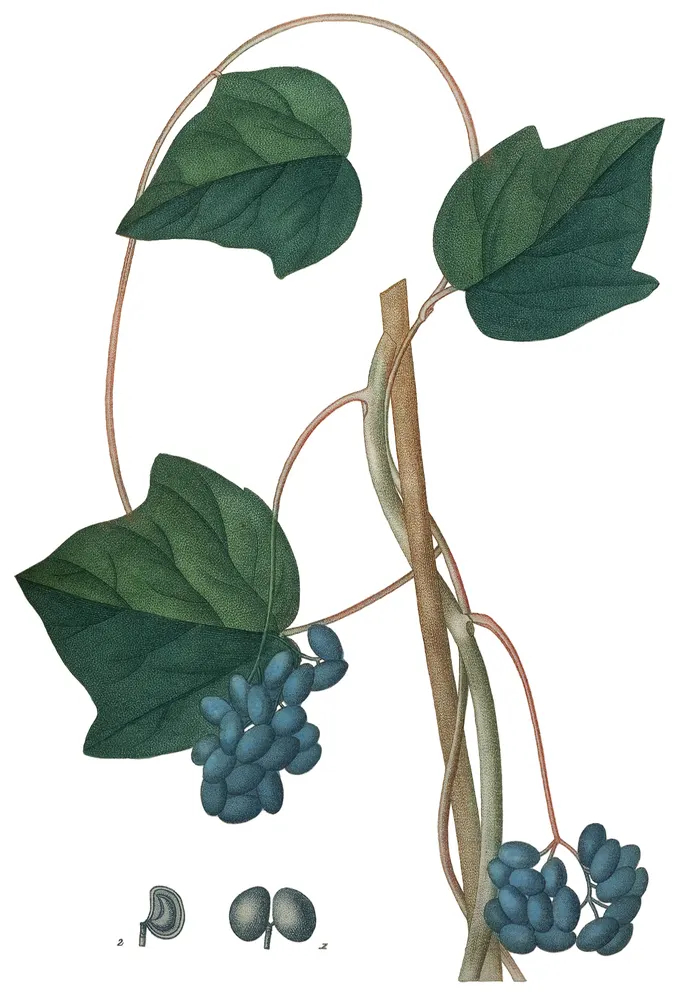
Photo: Jaume Saint-Hilaire, Jean Henri,1772-1845., Public domain (via Wikimedia Commons)
Canadian Moonseed
Menispermum canadense
Also known as Moonseed, Common Moonseed, Yellow Parilla, Texas Sarsaparilla (historic trade name, unrelated to true sarsaparilla)
Key benefits
✦Traditional uses
✦Canadian moonseed carries a long, complicated history in North American folk medicine. Some Native American communities and, later, nineteenth century eclectic physicians used small amounts of the dried root as a bitter tonic and blood purifier, and in washes for skin complaints, often grouping it with other bitter roots of the era. The plant also earned the trade name yellow parilla because it was sometimes substituted for true sarsaparilla in old pharmacy formulas. Modern herbalism has largely set moonseed aside, since its alkaloid content makes it unpredictable and its berries are dangerously easy to confuse with wild grapes, so today the plant is valued far more as a woodland curiosity and a lesson in careful identification than as a remedy.
How to grow & use it
✦The full apothecary for Canadian Moonseed
Traditional remedies and step-by-step preparations, a complete growing guide, and how to harvest, dry, and store it, all unlocked with HerbLens Unlimited.
- ✦Remedies & preparations
- ✦ Growing guide
- ✦Harvest & storage
From under $6 a month. Free plant identifications always included.
- ✦Wild grape (for contrast in identification walks)
- ✦Virginia creeper (another common climbing look-alike)
“The moon-marked vine at the woodland's edge, worth learning by sight and admiring from a respectful distance.”
The genus name Menispermum comes from the Greek mene, meaning moon, and sperma, meaning seed, a nod to the single crescent-shaped seed tucked inside each berry, which is also the surest way to tell this toxic vine apart from an otherwise nearly identical bunch of wild grapes.
Canadian moonseed is toxic and should never be eaten. Every part of the plant, especially the small blue-black berries, contains isoquinoline alkaloids such as dauricine, and the berries are notorious for looking almost exactly like wild grapes (Vitis species), a resemblance that has led to real poisoning cases, including in children who mistook them for fruit. Symptoms of ingestion can include nausea, vomiting, and convulsions, and severe cases have been fatal. The clearest way to tell it apart from true wild grape is the seed, moonseed carries a single flattened, crescent-moon-shaped seed while a true grape holds several round ones, but this distinction should only ever be used to avoid the plant, never to justify eating it. Root preparations recorded by nineteenth century eclectic physicians are not considered safe by modern standards and are not recommended today. Keep it away from children and pets, never forage the berries, and if accidental ingestion occurs, contact a poison control center or medical professional right away.