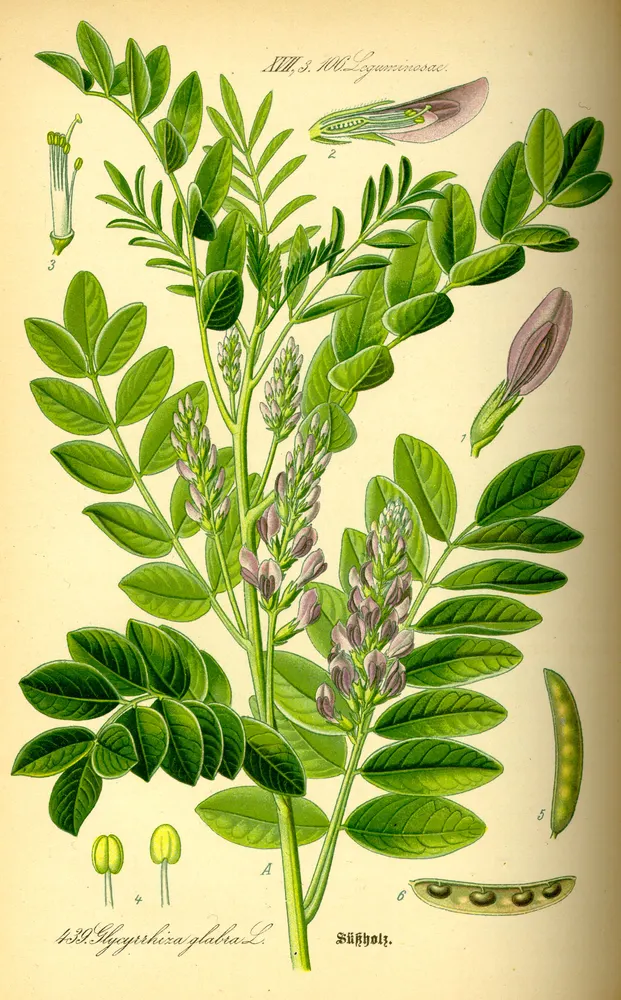
Photo: Public domain (via Wikimedia Commons)
Licorice
Glycyrrhiza glabra
Also known as Licorice root, Sweet root, Sweetwood, Liquorice, Yasti-madhu
Key benefits
✦Traditional uses
✦Licorice root has been chewed, brewed, and stirred into remedies for thousands of years, turning up in ancient Egyptian tombs, Chinese medicine chests, and the satchels of Ayurvedic healers alike. It was traditionally reached for to soothe an irritated throat, ease a lingering cough, and calm a fussy stomach, its natural sweetness making it as welcome in a remedy as it was in candy tins. In traditional Chinese medicine it earned the nickname the great harmonizer, prized for its ability to balance and moderate other herbs in a formula. Licorice sticks were also simply chewed as a sweet treat long before refined sugar was common, a habit that has never quite gone out of style.
How to grow & use it
✦The full apothecary for Licorice
Traditional remedies and step-by-step preparations, a complete growing guide, and how to harvest, dry, and store it, all unlocked with HerbLens Unlimited.
- ✦Remedies & preparations
- ✦ Growing guide
- ✦Harvest & storage
From under $6 a month. Free plant identifications always included.
- ✦Ginger
- ✦Marshmallow root
- ✦Chamomile
- ✦Marshmallow root (for soothing, demulcent qualities without the sweetness)
- ✦Astragalus (in traditional Chinese formulas, for a milder harmonizing herb)
“For the herb that has soothed throats and sweetened remedies since the time of pharaohs.”
The compound that gives licorice root its intense sweetness, glycyrrhizin, is roughly 50 times sweeter than table sugar by weight, which is exactly why the root was historically chewed on its own as a treat.
Licorice root deserves real caution: its glycyrrhizin can raise blood pressure and deplete potassium with regular use, and it should be avoided with high blood pressure, heart or kidney disease, low potassium, or pregnancy. It can interact with blood pressure medications, diuretics, corticosteroids, and digoxin, so don't combine them without medical guidance. Deglycyrrhizinated licorice (DGL), with this compound removed, is the safer choice for regular use.