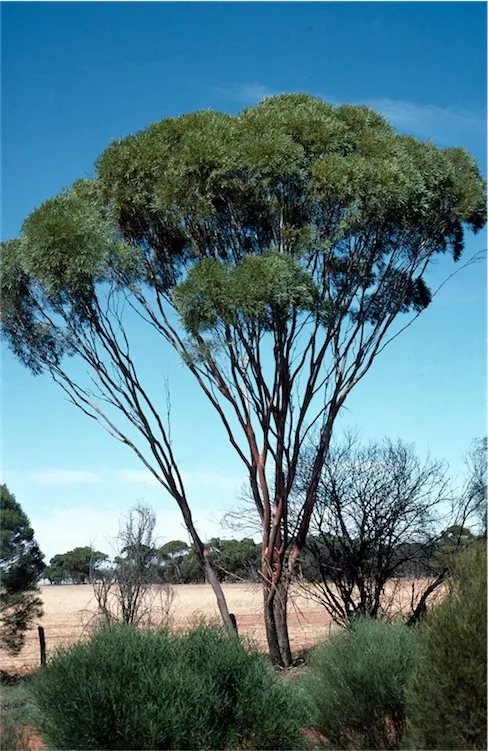
Photo: Ian Brooker and David Kleinig, CC BY 3.0 au (via Wikimedia Commons)
Oil Mallee
Eucalyptus kochii
Also known as Kochii Mallee, Narrow-leaved Oil Mallee
Key benefits
✦Traditional uses
✦For generations, people across the eucalypt country of Western Australia have turned to the sharp, camphor-sweet leaves of mallee eucalypts like Eucalyptus kochii for relief from coughs, colds, and heavy chests. Aboriginal Australians crushed and steamed the aromatic foliage of local eucalypts to help clear the airways and ease fever, a practice that settlers later adapted into the now-familiar ritual of eucalyptus steam inhalation. Eucalyptus kochii itself became the backbone of Western Australia's modern oil mallee industry, its narrow leaves yielding an exceptionally pure, high-cineole oil that growers and herbalists still prize today. Long before it was bottled and sold, that same bracing scent simply meant one thing to households nearby, that a cold was about to meet its match.
How to grow & use it
✦The full apothecary for Oil Mallee
Traditional remedies and step-by-step preparations, a complete growing guide, and how to harvest, dry, and store it, all unlocked with HerbLens Unlimited.
- ✦Remedies & preparations
- ✦ Growing guide
- ✦Harvest & storage
From under $6 a month. Free plant identifications always included.
- ✦Peppermint
- ✦Thyme
- ✦Rosemary
- ✦Eucalyptus globulus
- ✦Tea tree (Melaleuca)
“When you want a bracing, clean-scented ally to cut through a stuffy head and open a heavy chest.”
Beyond its fragrant oil, Eucalyptus kochii has a second job in Western Australia's wheatbelt, its deep roots are planted in long rows between crops to pull excess water from the soil and hold back the rising salt that has plagued the region's farmland, so the tree that clears a stuffy chest also helps clear the land.
The concentrated essential oil of oil mallee is genuinely dangerous if swallowed, even a teaspoon can seriously poison a small child, so keep it out of reach and use only externally or as vapor. Do not hold steam preparations close to the face of infants or young children.