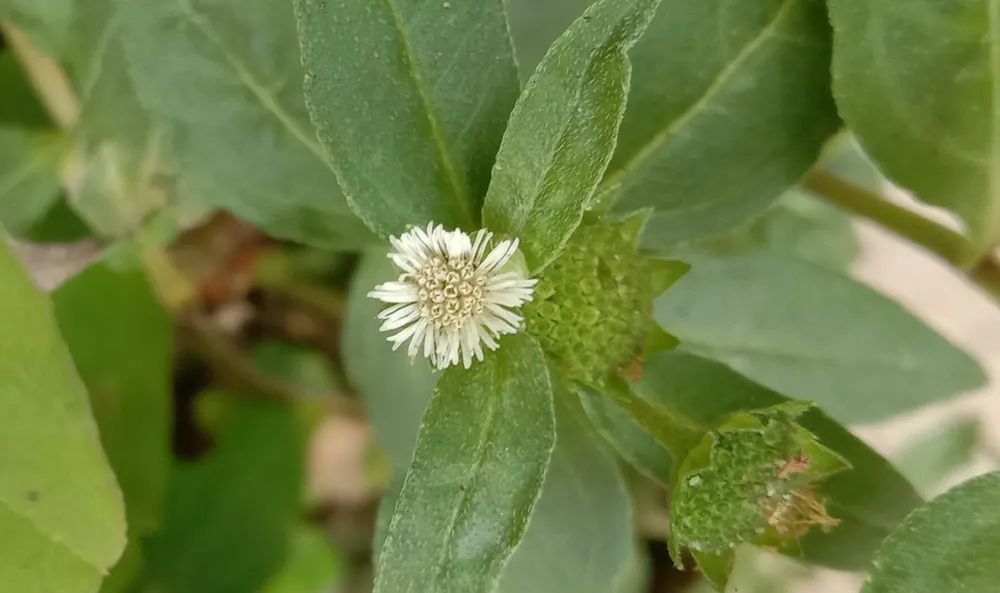
Photo: Billjones94, CC BY-SA 4.0 (via Wikimedia Commons)
False Daisy
Eclipta prostrata
Also known as Bhringraj, Kesuti, Han Lian Cao, Yerba de Tago, Trailing Eclipta
Key benefits
✦Traditional uses
✦Under the name bhringraj, False Daisy has held a central place in Ayurvedic medicine for centuries, where it was steeped in oil and worked into the scalp to nourish the hair and, tradition held, keep it dark and thick into old age. In classical Chinese medicine it appears as Han Lian Cao, a cooling herb traditionally taken to support the liver and kidneys. Village herbalists across South and Southeast Asia also turned to the crushed fresh leaf as a simple field remedy for small cuts, insect bites, and skin irritation. Its name comes from the way the fresh-cut stem darkens to an inky black within moments of exposure to air, a trait old herbals connected to its long association with hair and pigment.
How to grow & use it
✦The full apothecary for False Daisy
Traditional remedies and step-by-step preparations, a complete growing guide, and how to harvest, dry, and store it, all unlocked with HerbLens Unlimited.
- ✦Remedies & preparations
- ✦ Growing guide
- ✦Harvest & storage
From under $6 a month. Free plant identifications always included.
- ✦Amla (Indian gooseberry)
- ✦Hibiscus
- ✦Curry leaf
- ✦Amla
- ✦Nettle leaf
“For the quiet, patient rituals of nourished hair and a settled liver, the old apothecary's answer was always this humble ditch-side daisy.”
Snap a fresh False Daisy stem and the sap oxidizes to a deep blue-black within seconds, a trait so distinctive that it has been used for centuries in India as a natural dye and temporary hair and eyebrow tint.
False daisy isn't recommended during pregnancy or breastfeeding, and anyone with a liver condition or on liver-processed medication should check with a doctor first, given its traditional use for liver support. Topical use can occasionally irritate skin, and it should be avoided by anyone allergic to daisy-family plants.