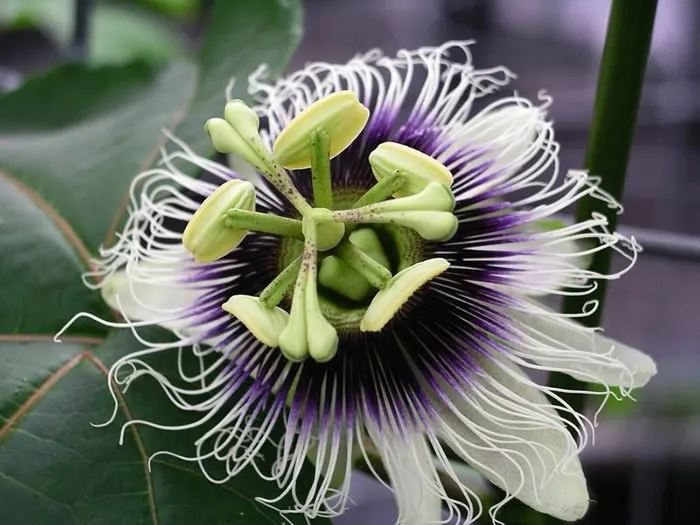
Photo: Unknown authorUnknown author, Public domain (via Wikimedia Commons)
Passionfruit
Passiflora edulis
Also known as Purple Granadilla, Maracuyá, Passion Vine
Key benefits
✦Traditional uses
✦Long before passionfruit found its way into juices and desserts around the world, South American communities were steeping its leaves into a mild evening tea to quiet a restless mind after a long day. The vine takes its common name from Spanish missionaries in the sixteenth century, who read the flower's unusual parts as symbols of the crucifixion, the corona as a crown of thorns, the five petals and five sepals as ten faithful apostles. Its fruit, meanwhile, became a staple of tropical kitchens for its perfumed, tart pulp, prized as much for pleasure as for the way it seemed to settle the stomach after a heavy meal.
How to grow & use it
✦The full apothecary for Passionfruit
Traditional remedies and step-by-step preparations, a complete growing guide, and how to harvest, dry, and store it, all unlocked with HerbLens Unlimited.
- ✦Remedies & preparations
- ✦ Growing guide
- ✦Harvest & storage
From under $6 a month. Free plant identifications always included.
- ✦Lemon balm
- ✦Chamomile
- ✦Valerian
- ✦Passiflora incarnata (maypop)
- ✦Lemon balm
“When you want a taste of the tropics on your tongue, or a gentle hand to help the evening slow down.”
The passionflower's elaborate bloom was so striking to sixteenth-century Spanish missionaries that they used it as a teaching tool, mapping its fringed corona, five stamens, and three stigmas onto the story of the crucifixion to explain the faith to people who had never heard it.
Ripe passionfruit pulp is a safe, everyday food. Unripe fruit, large amounts of seeds, and raw leaves or stems contain small amounts of cyanogenic compounds and shouldn't be eaten; traditional leaf tea is best avoided in pregnancy or alongside sedative medication.