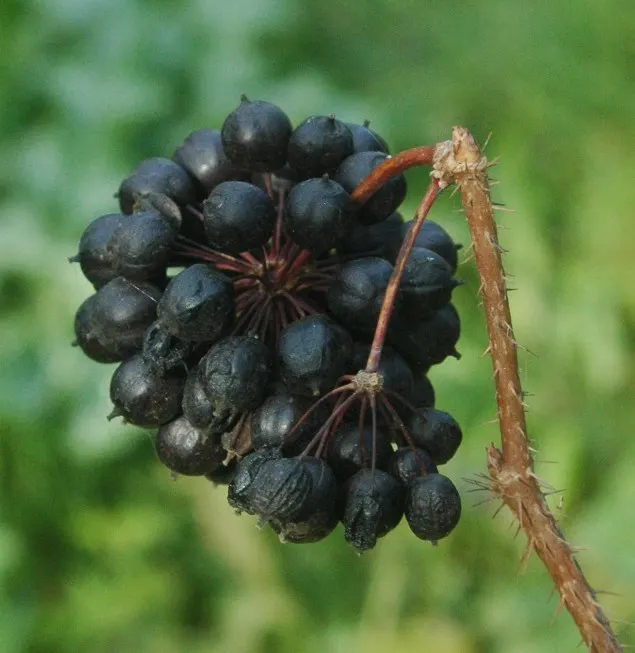
Photo: Stanislav Doronenko, CC BY 2.5 (via Wikimedia Commons)
Siberian Ginseng
Eleutherococcus senticosus
Also known as Eleuthero, Devil's Shrub, Touch-Me-Not, Ci Wu Jia, Wild Pepper
Key benefits
✦Traditional uses
✦In the forests of the Russian Far East and northeastern China, eleuthero's gnarled, spiny roots were dug and simmered into tonics meant to help the body cope with cold, hunger, and hard labor. Practitioners of traditional Chinese medicine have long known it as ci wu jia, using it to fortify qi and support vitality much as they used its costlier cousin, Panax ginseng. It entered Western herbalism in the twentieth century, when Soviet researchers studying folk tonics popularized eleuthero as a cheaper, more sustainable adaptogen, and it was famously given to factory workers, soldiers, and Olympic athletes to help them handle exertion and stress. That history earned it a lasting place as one of the great steadying roots of the herbal world.
How to grow & use it
✦The full apothecary for Siberian Ginseng
Traditional remedies and step-by-step preparations, a complete growing guide, and how to harvest, dry, and store it, all unlocked with HerbLens Unlimited.
- ✦Remedies & preparations
- ✦ Growing guide
- ✦Harvest & storage
From under $6 a month. Free plant identifications always included.
- ✦Astragalus root
- ✦Rhodiola rosea
- ✦Schisandra berry
- ✦Panax ginseng
- ✦Rhodiola rosea
“For the long, steady climb rather than the quick sprint, when what you need is grounded staying power.”
The word "adaptogen" itself grew up around this plant. Soviet scientist Israel Brekhman studied eleuthero extensively in the mid-1900s and helped define the term for substances that help the body adapt to stress, and eleuthero became one of the first herbs marketed under that name, given to Soviet athletes, cosmonauts, and factory workers to help them endure hard conditions.
Siberian ginseng is a different plant from Panax ginseng despite the shared name. It may interact with blood thinners, diabetes medication, sedatives, and heart medications like digoxin, and it has traditionally been avoided during pregnancy and breastfeeding.