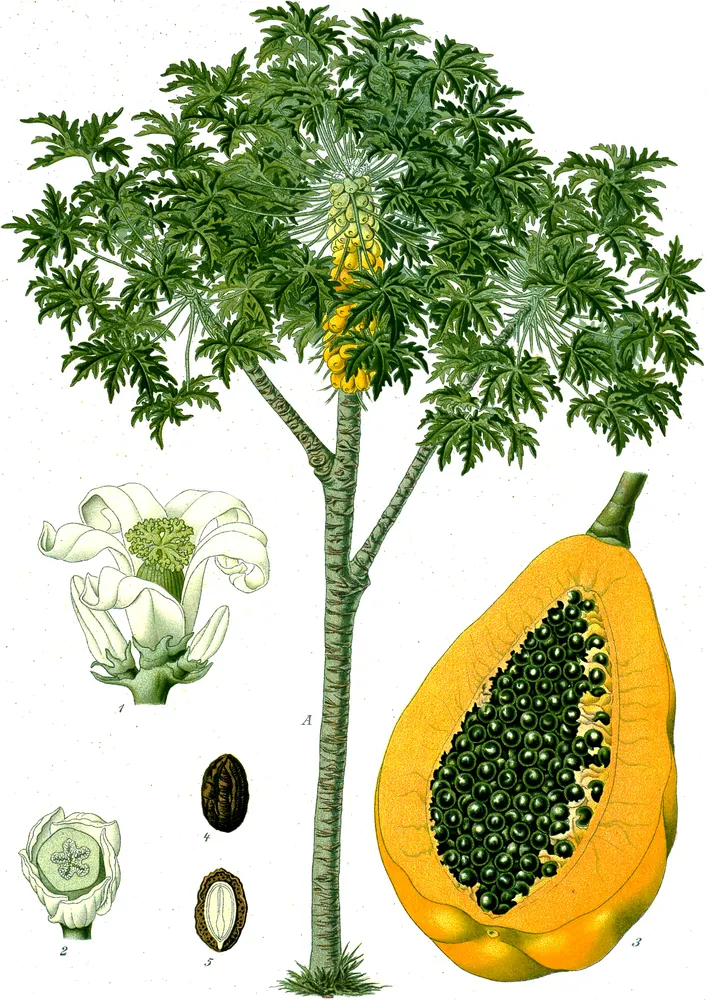
Photo: Franz Eugen Köhler, Köhler's Medizinal-Pflanzen, Public domain (via Wikimedia Commons)
Papaya
Carica papaya
Also known as Pawpaw, Papaw, Tree Melon, Mamão
Key benefits
✦Traditional uses
✦Long before papaya became a supermarket staple, it was a household remedy across Central America, the Caribbean, West Africa, and Southeast Asia, where the leaves were brewed into a bitter tea and traditionally reached for after heavy meals to ease digestion. The milky latex of the unripe fruit was traditionally dabbed onto minor skin troubles, and the ripe fruit itself was treasured as a gentle, easily digested food for those recovering from illness. Sailors and travelers in the tropics came to know papaya simply as a plant that helped the stomach do its work, a reputation that traveled with the fruit as it spread from its Central American homeland around the world.
How to grow & use it
✦The full apothecary for Papaya
Traditional remedies and step-by-step preparations, a complete growing guide, and how to harvest, dry, and store it, all unlocked with HerbLens Unlimited.
- ✦Remedies & preparations
- ✦ Growing guide
- ✦Harvest & storage
From under $6 a month. Free plant identifications always included.
- ✦Ginger
- ✦Lemongrass
- ✦Fresh mint
- ✦Fresh ginger tea
- ✦Dandelion leaf tea
“When the stomach feels heavy after a rich meal and you want a gentle, green, leafy ally rather than something sharp.”
Papain, the protein-digesting enzyme papaya is famous for, is the same enzyme long used to tenderize tough cuts of meat and to clear the haze from home-brewed beer, and it is drawn from the milky latex of the unripe fruit rather than the sweet ripe flesh most people eat.
Ripe papaya is a safe, common food, but unripe fruit, seeds, and the milky latex can irritate the stomach and have traditionally been avoided in pregnancy for a possible uterine effect. The latex can also trigger reactions in people with a latex allergy and may affect blood clotting alongside blood thinners like warfarin.