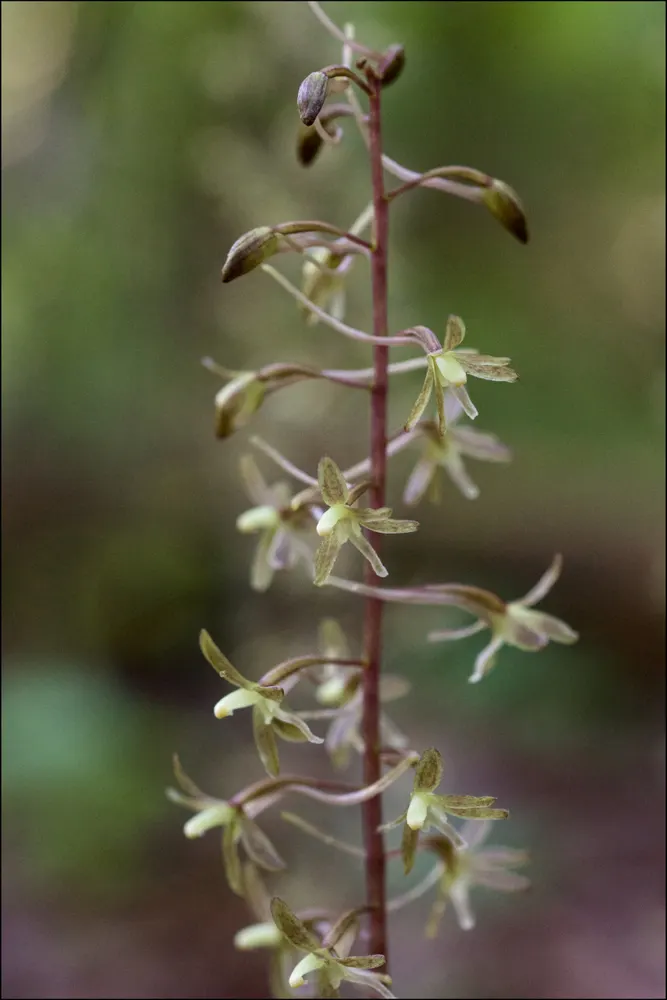
Photo: Eric Hunt, CC BY-SA 4.0 (via Wikimedia Commons)
Cranefly Orchid
Tipularia discolor
Also known as Crippled Cranefly, Crane-fly Orchid, Elfin Spur Orchid
Key benefits
✦Traditional uses
✦Tipularia discolor has never been a plant of the apothecary shelf, it belongs instead to the quiet folklore of the forest floor. Naturalists have long delighted in its odd habits, the way it sends up a single dark leaf each autumn when everything else is going dormant, then lets that leaf wither away before its flowers ever appear the following summer. Early botanists puzzled over its ghostly, leafless bloom stalk and the small, lopsided flowers that seem to hover on wiry legs like the crane flies they are named for. While people walking these same woods for centuries surely noticed the plant tucked among the oaks and pines, no reliable record survives of it being used as food or medicine, and it is best understood today as a treasure for the eye and the field notebook rather than the herbalist's kit.
How to grow & use it
✦The full apothecary for Cranefly Orchid
Traditional remedies and step-by-step preparations, a complete growing guide, and how to harvest, dry, and store it, all unlocked with HerbLens Unlimited.
- ✦Remedies & preparations
- ✦ Growing guide
- ✦Harvest & storage
From under $6 a month. Free plant identifications always included.
“For the woodland walker who notices what everyone else steps over, the single purple-backed leaf keeping quiet watch through winter's bare months.”
The cranefly orchid's flowers are lopsided on purpose. Each blossom's pollen sacs are angled to stick to only one eye of a visiting noctuid moth, alternating left and right eye from flower to flower, a clever trick that helps make sure the moth carries pollen onward to a different cranefly orchid instead of wasting it on the one it just left.
Tipularia discolor has no established history of medicinal or culinary use and no reliable safety data exists for eating or brewing it, so it should never be treated as a food or herbal preparation of any kind. As a native terrestrial orchid it is also slow growing and highly sensitive to disturbance, with many populations declining from habitat loss, and digging or transplanting one is both usually fatal to the plant and something conservation-minded foragers should avoid entirely. If you are ever uncertain about identifying this or any wild plant, consult a qualified botanist, local extension office, or naturalist before making decisions involving it.