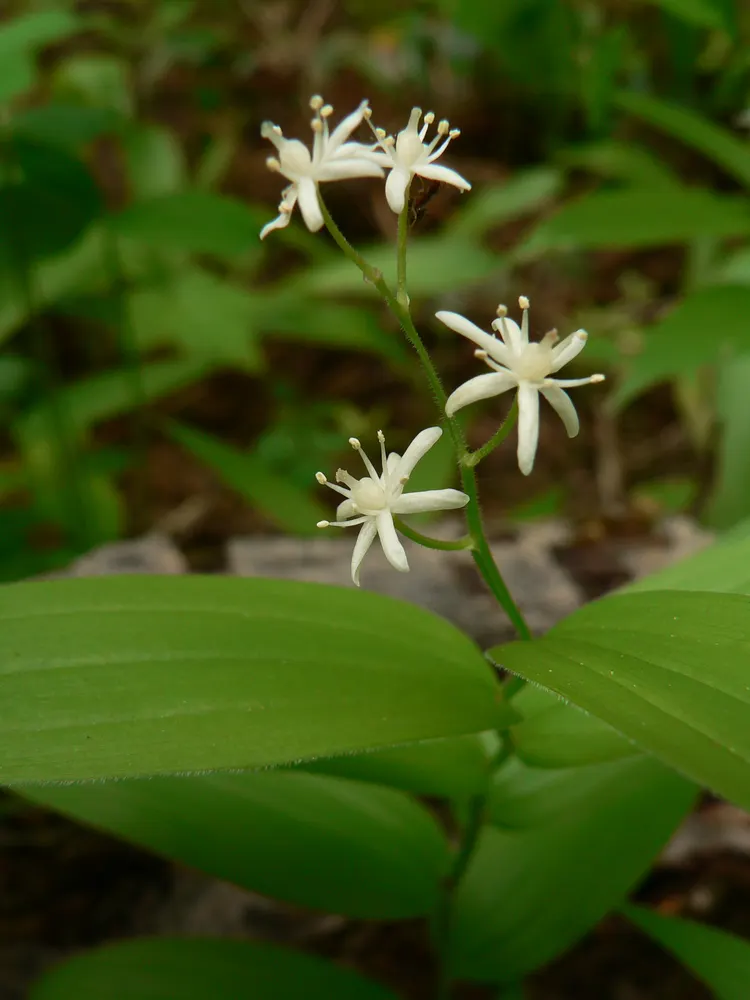
Photo: Walter Siegmund (talk), CC BY 2.5 (via Wikimedia Commons)
Starry False Solomon's Seal
Maianthemum stellatum
Also known as Starry False Lily of the Valley, Star-flowered Solomon's Plume, Smilacina stellata (older botanical name), Smilacina stellata
Key benefits
✦Traditional uses
✦Long before it had a Latin name, this quiet woodland lily was known to dozens of Native American nations, from the Ojibwe and Potawatomi to the Karuk and Thompson peoples, who dug its slender rhizome for use as a wash on wounds, sores, and skin troubles, and sometimes as an eyewash or general tonic. Its young shoots, gathered while still tender in early spring, were cooked and eaten much like asparagus, one of the first fresh greens after a long winter. The ripe berries, which start green and purple striped before turning a translucent ruby red, were eaten too, though always in modest amounts, since larger quantities were known to unsettle the stomach.
How to grow & use it
✦The full apothecary for Starry False Solomon's Seal
Traditional remedies and step-by-step preparations, a complete growing guide, and how to harvest, dry, and store it, all unlocked with HerbLens Unlimited.
- ✦Remedies & preparations
- ✦ Growing guide
- ✦Harvest & storage
From under $6 a month. Free plant identifications always included.
- ✦Plantain
- ✦Yarrow
- ✦True Solomon's Seal (Polygonatum biflorum)
- ✦True Solomon's Seal (Polygonatum biflorum)
“For the hush of the early forest, when a scatter of tiny white stars opens along the woodland floor before the summer canopy closes overhead.”
This plant used to be classified in its own genus, Smilacina, and is easy to tell apart from true Solomon's seal by looking at the flowers: starry false Solomon's seal blooms in a small cluster right at the tip of the stem, while true Solomon's seal's flowers dangle in quiet pairs beneath the leaves all along the stem.
The rhizome and berries contain natural saponins, and eating them in quantity can cause nausea or a laxative effect. Young shoots and berries grow alongside seriously toxic look-alikes, so positive identification is essential, and use in pregnancy is best avoided.