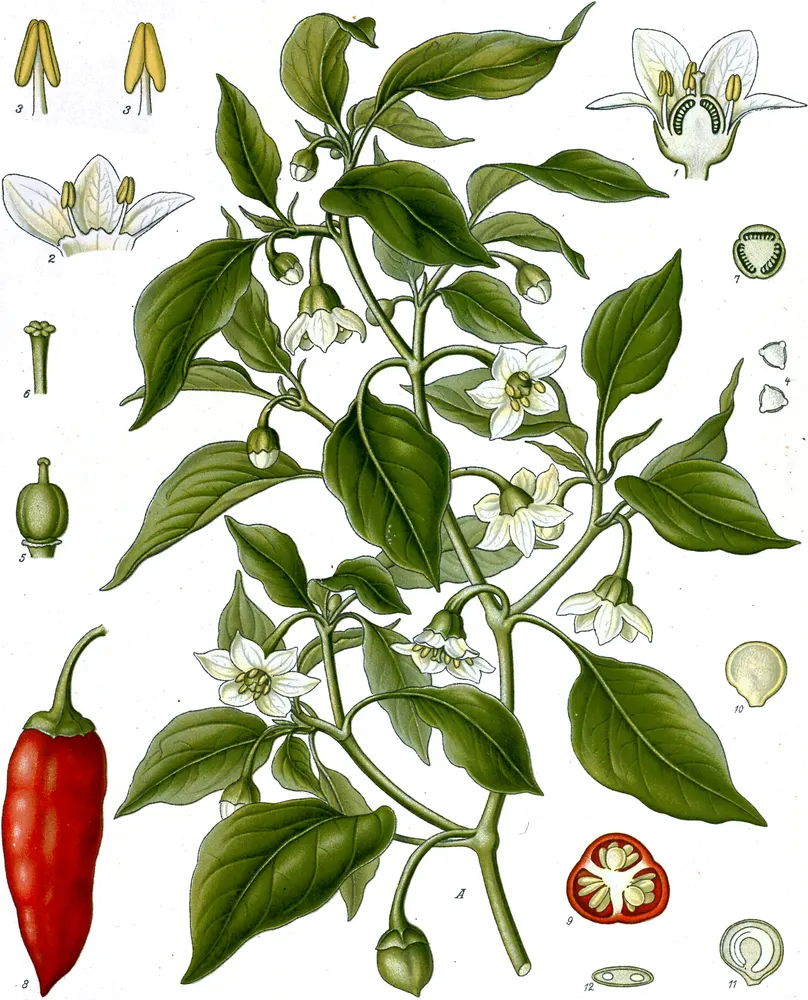
Photo: Franz Eugen Köhler, Köhler's Medizinal-Pflanzen, Public domain (via Wikimedia Commons)
Cayenne Pepper
Capsicum annuum
Also known as Chili Pepper, Red Pepper, Bird Pepper, Guinea Spice
Key benefits
✦Traditional uses
✦Long before it lit up cuisines around the world, cayenne pepper was a cornerstone remedy among Indigenous peoples of Central and South America, who used it to warm the body, ease digestion, and treat wounds. In the early 1800s, the American herbalist Samuel Thomson built much of his popular healing system around cayenne, calling it a way to 'raise the internal heat' and move sluggish circulation. Herbalists since have reached for a pinch of cayenne to stoke a weak appetite, encourage warmth in cold hands and feet, and, rubbed on as an infused oil, to ease sore, aching muscles from the outside in.
How to grow & use it
✦The full apothecary for Cayenne Pepper
Traditional remedies and step-by-step preparations, a complete growing guide, and how to harvest, dry, and store it, all unlocked with HerbLens Unlimited.
- ✦Remedies & preparations
- ✦ Growing guide
- ✦Harvest & storage
From under $6 a month. Free plant identifications always included.
- ✦Ginger
- ✦Cinnamon
- ✦Black Pepper
- ✦Paprika (milder)
- ✦Ginger
“When you need to light a small fire in cold hands, a sluggish appetite, or an achy shoulder.”
The Scoville scale, the measure everyone uses to rank how hot a pepper is, was invented in 1912 by pharmacist Wilbur Scoville specifically to test the potency of Capsicum peppers like cayenne.
Capsaicin is a strong irritant to eyes and skin, so wash your hands well after handling it and avoid touching your face. In large amounts it can worsen acid reflux or ulcers and may interact with blood pressure or blood-thinning medications.