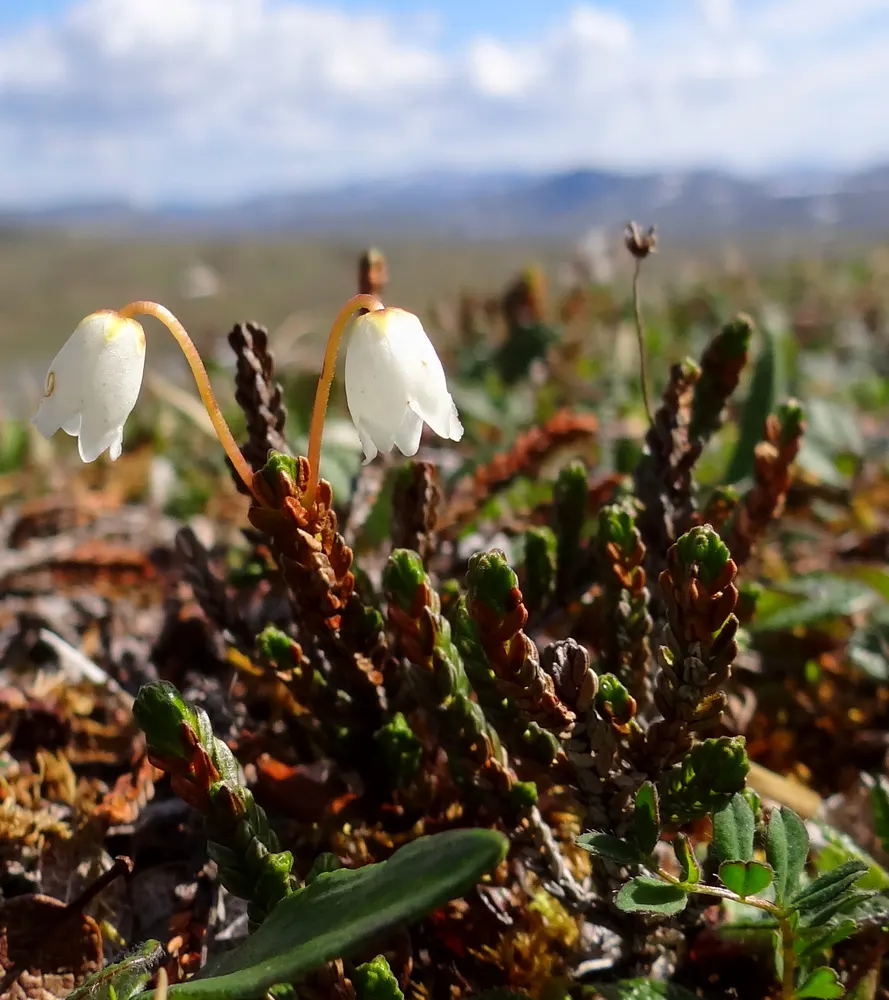
Photo: Bjørn Christian Tørrissen, CC BY-SA 3.0 (via Wikimedia Commons)
Arctic Bell-Heather
Cassiope tetragona
Also known as Arctic White Heather, Four-Angled Cassiope, Arctic Mountain Heather
Key benefits
✦Traditional uses
✦In the treeless Arctic, wood for fire is scarce, and for generations Inuit and other circumpolar peoples gathered the dry, tangled stems of Cassiope tetragona as reliable kindling and fuel, since its wiry branches burn readily even when little else will. It has never carried a meaningful tradition as a food or medicine plant, but it holds a different kind of value: because each small plant lays down growth segments year after year in a cold, unhurried rhythm, scientists now read old cushions of Cassiope like tiny tree rings to reconstruct centuries of Arctic climate. Today it is prized less for utility and more for its quiet toughness, a plant that carpets the harshest ground on earth in tidy green mats and rings of white bells.
How to grow & use it
✦The full apothecary for Arctic Bell-Heather
Traditional remedies and step-by-step preparations, a complete growing guide, and how to harvest, dry, and store it, all unlocked with HerbLens Unlimited.
- ✦Remedies & preparations
- ✦ Growing guide
- ✦Harvest & storage
From under $6 a month. Free plant identifications always included.
- ✦Mountain avens (Dryas octopetala)
- ✦Arctic willow (Salix arctica)
- ✦Diapensia (Diapensia lapponica)
- ✦Cassiope mertensiana
- ✦Winter heath (Erica carnea) for gardeners in milder climates
“For the gardener chasing a small, stubborn piece of the true north.”
Because Cassiope tetragona grows so slowly and adds a distinct segment of stem each year, climate scientists use preserved cushions of it, some over a century old, almost like tree rings, to reconstruct summers on the tundra long before weather records began.
Arctic bell-heather has no history of use as food or medicine and shouldn't be eaten, since some heath-family relatives are genuinely toxic. It grows slowly in fragile tundra, so it's best left undisturbed rather than harvested.