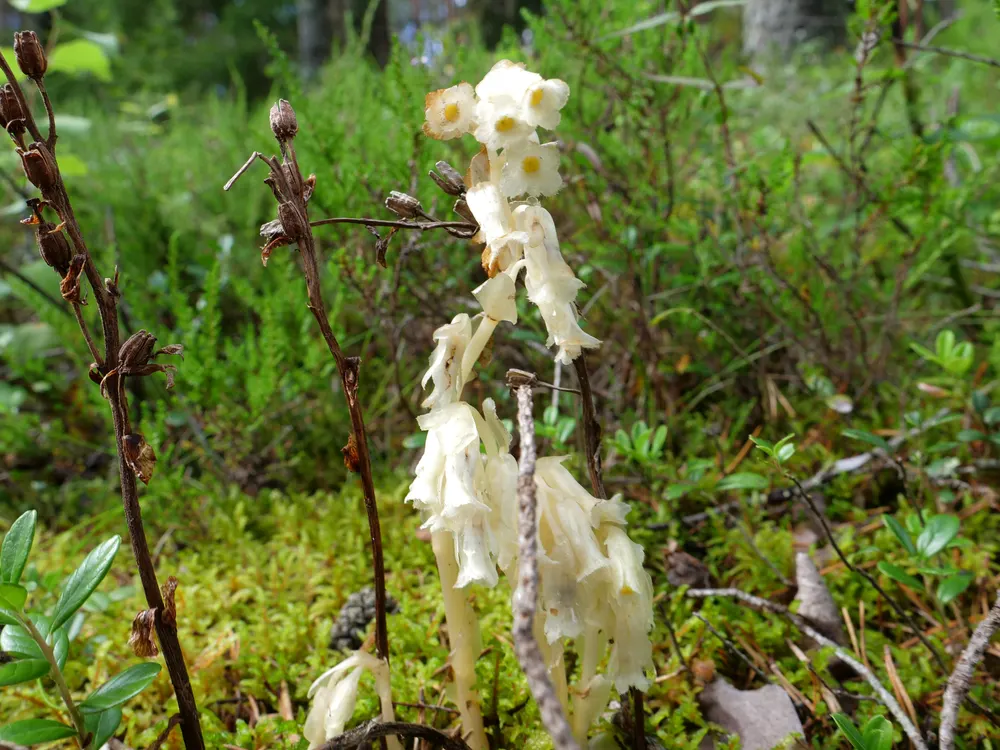
Photo: Leonhard Lenz, CC BY-SA 4.0 (via Wikimedia Commons)
Pinesap
Hypopitys monotropa
Also known as Pinesap, Yellow Bird's-Nest, Dutchman's Pipe (older folk name, not Aristolochia), False Beech-drops, Monotropa hypopitys
Key benefits
✦Traditional uses
✦Pinesap belongs to a strange and lovely little tribe of forest plants that gave up on sunlight altogether. Rather than photosynthesizing, it taps into the same underground fungal networks that feed the surrounding trees, drawing its nourishment secondhand from roots it never touches. Unlike its famous cousin ghost pipe, which carries some documented history of traditional use, pinesap itself has little separate record in herbal tradition. It has long been gathered instead by botanists, foragers, and forest walkers simply as a marvel to find and photograph, a reminder of how much of a forest's life happens out of sight underground.
How to grow & use it
✦The full apothecary for Pinesap
Traditional remedies and step-by-step preparations, a complete growing guide, and how to harvest, dry, and store it, all unlocked with HerbLens Unlimited.
- ✦Remedies & preparations
- ✦ Growing guide
- ✦Harvest & storage
From under $6 a month. Free plant identifications always included.
- ✦Ghost pipe (Monotropa uniflora), its closest relative and frequent neighbor
- ✦Coralroot orchids (Corallorhiza spp.), another chlorophyll-free woodland companion
- ✦Ghost pipe (Monotropa uniflora) is the plant most often mistaken for it, though neither has an established tradition of herbal use
“For the hushed thrill of finding a wildflower that never once turned green.”
Pinesap is not a fungus, even though it looks and grows like one. It is a true flowering plant that quietly cheats the forest economy: it plugs into mycorrhizal fungi that are simultaneously feeding sugars to nearby pine and oak trees, and siphons off a share for itself, all without ever making a scrap of chlorophyll of its own.
Pinesap has no meaningful history as food or medicine and isn't eaten or applied to the skin. It depends on an underground fungal partnership to survive, so picking or transplanting it almost always kills it.