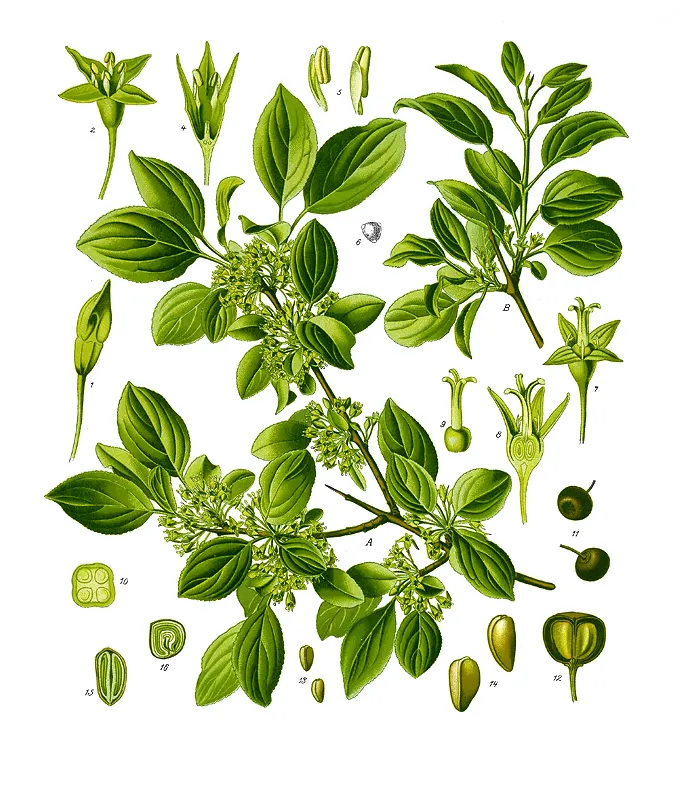
Photo: Köhler, F. E. (Franz Eugen), Public domain (via Wikimedia Commons)
Common Buckthorn
Rhamnus cathartica
Also known as Purging Buckthorn, European Buckthorn, Waythorn, Hart's Thorn, Highway Thorn
Key benefits
✦Traditional uses
✦For hundreds of years, European apothecaries dried and carefully aged the bark of Rhamnus cathartica before grinding it into a stern purgative, one so forceful that herbals from Culpeper's era onward warned it should never be used fresh. As gentler laxative herbs came into favor, buckthorn bark quietly fell out of common practice and today survives mostly as a footnote in old materia medica rather than a living remedy. The unripe berries had a gentler legacy of their own, boiled down by medieval manuscript illuminators and later by watercolorists into the rich, transparent pigment known as sap green. Its old country names, waythorn and highway thorn, remember how commonly it once grew along the hedged lanes and drovers' roads of the English countryside.
How to grow & use it
✦The full apothecary for Common Buckthorn
Traditional remedies and step-by-step preparations, a complete growing guide, and how to harvest, dry, and store it, all unlocked with HerbLens Unlimited.
- ✦Remedies & preparations
- ✦ Growing guide
- ✦Harvest & storage
From under $6 a month. Free plant identifications always included.
- ✦Ginger
- ✦Fennel
- ✦Licorice root
- ✦Cascara sagrada
- ✦Senna leaf
“Not for the teacup, but worth knowing by sight: the thorn-tipped hedgerow shrub with glossy black berries that birds relish and children should never touch.”
The unripe, still-green berries of common buckthorn were once simmered down by medieval manuscript illuminators to produce sap green, a luminous, transparent pigment later prized by watercolor painters for rendering foliage and shadow.
Rhamnus cathartica is not a plant to steep and drink. Fresh bark and fresh or unripe berries contain anthraquinone glycosides that act as a harsh, unpredictable purgative, and cases of children and pets becoming seriously ill after eating the shiny black berries are well documented, with symptoms including violent vomiting, diarrhea, cramping, and dehydration. Even old herbals that called for the dried bark insisted it be aged a full year first, because fresh material was considered too strong and irritating to use safely. This kind of unregulated purging can also worsen electrolyte loss in ways that are dangerous for anyone on heart medications, diuretics, or digoxin, and it should never be used during pregnancy or nursing or given to children. In much of North America, common buckthorn is additionally classified as an invasive, regulated, or even banned species, so most people encounter it as something to remove rather than to grow or gather. Please do not attempt to prepare or ingest any part of this plant. Speak with a qualified healthcare provider or herbalist about safer options for digestive support.