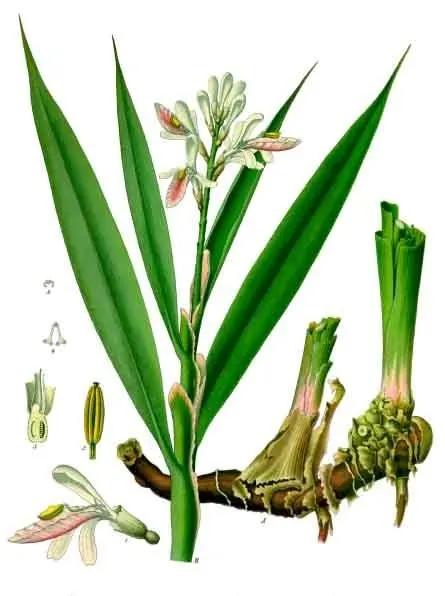
Photo: Franz Eugen Köhler, Köhler's Medizinal-Pflanzen, Public domain (via Wikimedia Commons)
Lesser Galangal
Alpinia officinarum
Also known as Galangal, Lesser Galangal, Chinese Ginger, East Indian Root, Kencur's Cousin
Key benefits
✦Traditional uses
✦Long before it traveled the spice routes into medieval European kitchens and apothecaries, lesser galangal was a staple of Chinese herbal medicine, where its warming, peppery rhizome was steeped and chewed to settle an unsettled stomach and chase away the chill of a sluggish digestion. Arab traders carried it west, and by the Middle Ages it was so prized that the herbalist and abbess Hildegard von Bingen wrote of galangal as a heart-strengthening spice worth its weight in gold. Across Southeast Asia it found a second life in the kitchen as much as the medicine chest, where cooks and healers alike have reached for its sharp, citrusy heat to warm the body and ease occasional aches. That dual identity, half spice rack and half remedy, is part of what makes galangal such an old and well-traveled friend.
How to grow & use it
✦The full apothecary for Lesser Galangal
Traditional remedies and step-by-step preparations, a complete growing guide, and how to harvest, dry, and store it, all unlocked with HerbLens Unlimited.
- ✦Remedies & preparations
- ✦ Growing guide
- ✦Harvest & storage
From under $6 a month. Free plant identifications always included.
- ✦Ginger
- ✦Turmeric
- ✦Lemongrass
- ✦Fresh ginger root
- ✦Greater galangal (Alpinia galanga)
“When the belly feels heavy and cold, and the spice rack needs a little fire.”
In Southeast Asian kitchens, galangal is the backbone of dishes like Thai tom yum soup, and its flavor is distinct enough from common ginger that cooks there rarely consider the two interchangeable, even though European herbals of the Middle Ages often lumped them together as one and the same root.
Lesser galangal is safe as a culinary spice, but those allergic to ginger, turmeric, or cardamom should be cautious, and concentrated extracts may thin the blood.