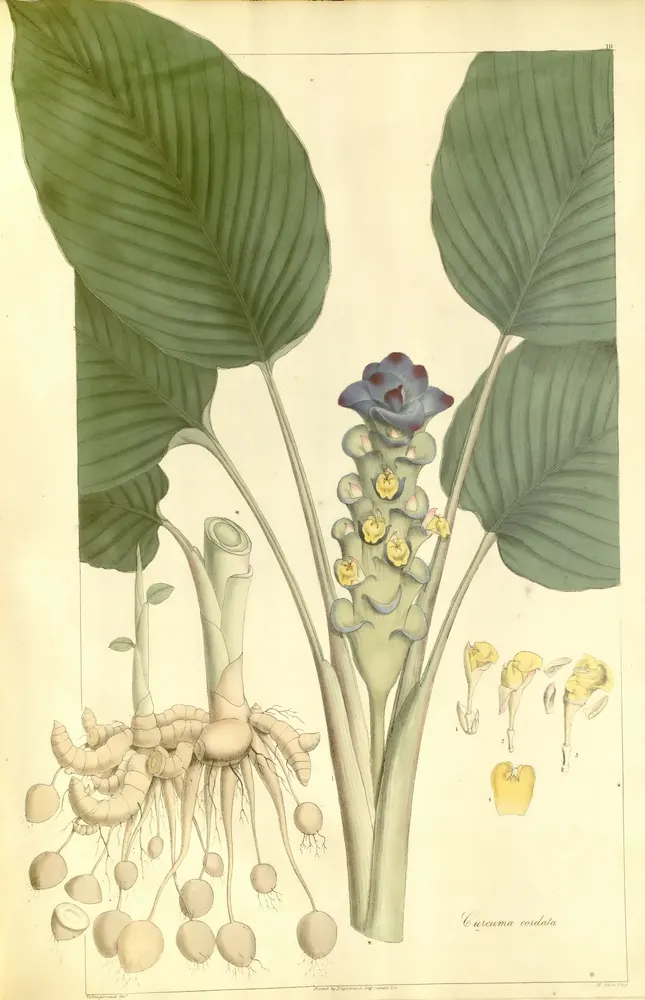
Photo: Nathaniel Wallich, Public domain (via Wikimedia Commons)
Queen Lily
Curcuma petiolata
Also known as Hidden Ginger, Malay Ginger, Queen Lily Ginger
Key benefits
✦Traditional uses
✦Queen Lily belongs to the same family as turmeric and true ginger, but it has traveled a different road, prized by gardeners for its broad tropical leaves and soft pink and green bracts rather than gathered for the kitchen or the medicine chest. In its native Southeast Asian forests it grows quietly in the shaded understory, and it was carried into gardens around the world chiefly for the pleasure of its foliage. Unlike its famous cousin Curcuma longa, no well-documented body of traditional medicinal use has come down to us for this particular species, so its story is really one of ornamental delight rather than remedy.
How to grow & use it
✦The full apothecary for Queen Lily
Traditional remedies and step-by-step preparations, a complete growing guide, and how to harvest, dry, and store it, all unlocked with HerbLens Unlimited.
- ✦Remedies & preparations
- ✦ Growing guide
- ✦Harvest & storage
From under $6 a month. Free plant identifications always included.
- ✦Hosta
- ✦Caladium
- ✦Hedychium (ginger lily)
- ✦Alpinia zerumbet (shell ginger)
- ✦Zingiber zerumbet (pinecone ginger)
“For the shaded, quiet corner of the garden that wants something lush and a little secretive.”
The common name Hidden Ginger comes from the way the flower spike is born low and tucked among the leaf bases rather than held up on a tall stalk like many of its ginger relatives, so the blooms seem to peek out shyly from the foliage instead of announcing themselves overhead.
Queen lily is grown as an ornamental, not a food or medicine, and its sap may mildly irritate sensitive skin during handling; keep pets and children from chewing the rhizomes.