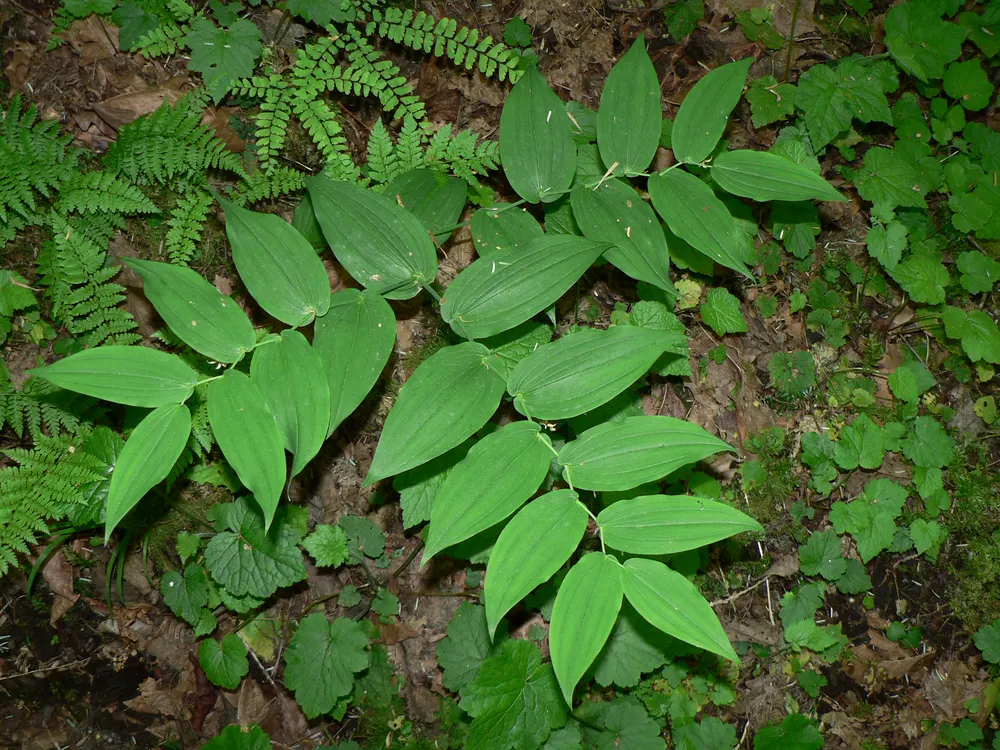
Photo: Walter Siegmund, CC BY 2.5 (via Wikimedia Commons)
Watermelon Berry
Streptopus amplexifolius
Also known as Watermelon Berry, Clasping-leaf Twisted-stalk, Scoot Berry, Liverberry
Key benefits
✦Traditional uses
✦Long before it had a place in any garden, watermelon berry fed the people who walked the cool understory of the northern forests. Indigenous nations across the boreal and coastal ranges of North America, from the Pacific Northwest up into Alaska and east through the Rockies, snapped the tender young shoots in earliest spring and ate them raw or lightly cooked, much like a woodland asparagus. By late summer the plant offered a second gift, small orange-red berries that dangle from twisted stalks beneath the leaves and taste startlingly like cucumber or watermelon rind, a sweet surprise found deep in the shade where little else tasted so bright. Early homesteaders and trappers who followed old forest trails learned the same lesson from their Indigenous neighbors, and the plant became a quiet, reliable marker of a healthy, moist old-growth forest.
How to grow & use it
✦The full apothecary for Watermelon Berry
Traditional remedies and step-by-step preparations, a complete growing guide, and how to harvest, dry, and store it, all unlocked with HerbLens Unlimited.
- ✦Remedies & preparations
- ✦ Growing guide
- ✦Harvest & storage
From under $6 a month. Free plant identifications always included.
- ✦Fiddlehead ferns
- ✦Wild ramps
- ✦Miner's lettuce
- ✦Asparagus (for the young shoots)
- ✦Cucumber (for the berries' cool, watery flavor)
“For the cool, green hush of a spring forest, and the surprise of a berry that tastes like watermelon growing wild in the shade.”
The name Streptopus comes from the Greek for twisted foot, a nod to the sharply kinked little stalk that holds each flower, and later each berry, hanging upside down beneath the leaves like a tiny lantern on a bent wire.
Watermelon berry is generally safe when correctly identified, though ripe berries can have a mild laxative effect in quantity. The young spring shoots grow alongside toxic look-alikes like false hellebore, so positive identification by an experienced forager is essential before eating any part of it.