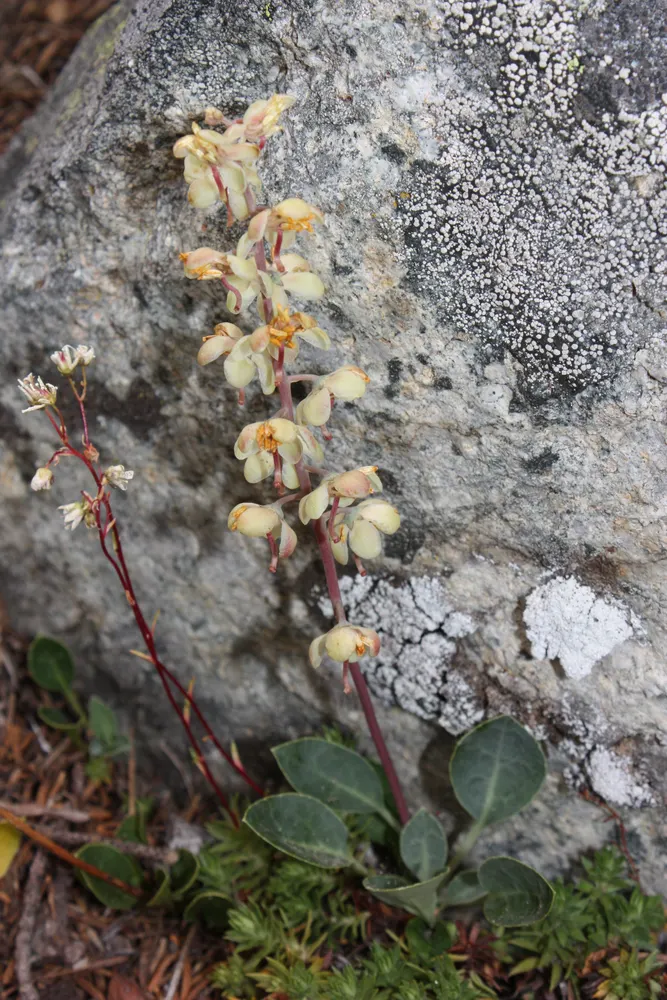
Photo: Walter Siegmund (talk), CC BY-SA 3.0 (via Wikimedia Commons)
White-veined Wintergreen
Pyrola picta
Also known as White-veined Shinleaf, White-veined Pyrola
Key benefits
✦Traditional uses
✦Long before it had a place in any garden bed, White-veined Wintergreen grew quietly in the shadowed duff beneath pines and firs, and it was there that various Native peoples of the Pacific Northwest and California came to know its leaves as a gentle wound helper. The leathery, dark green leaves, each one traced with pale silvery veins as though painted by hand, were gathered fresh and applied directly to cuts, sores, and irritated skin, or steeped into a cooling wash for the same purpose. It was never a plant of the pantry or the tea tin so much as one kept in memory for the trailside scrape or the small household injury, valued for its mild astringency rather than any dramatic cure. Because the plant depends on a delicate partnership with forest fungi to survive, it has always been gathered sparingly and left, for the most part, to keep its place on the forest floor.
How to grow & use it
✦The full apothecary for White-veined Wintergreen
Traditional remedies and step-by-step preparations, a complete growing guide, and how to harvest, dry, and store it, all unlocked with HerbLens Unlimited.
- ✦Remedies & preparations
- ✦ Growing guide
- ✦Harvest & storage
From under $6 a month. Free plant identifications always included.
- ✦Plantain
- ✦Self-heal
- ✦Yarrow
- ✦Pipsissewa (Chimaphila umbellata)
- ✦Self-heal (Prunella vulgaris)
“For the hushed, needle-strewn corners of the forest floor, where little else chooses to grow.”
The species name picta means painted in Latin, a nod to the frosted, silver-white veining that runs across each dark leaf, a pattern so distinctive that foragers can spot the plant in deep forest shade long before they see its flowers.
White-veined wintergreen has little documented history of internal use beyond a mild external wash, so it's best avoided during pregnancy, while nursing, or for children. Correct identification matters since it grows among similar-looking woodland plants.