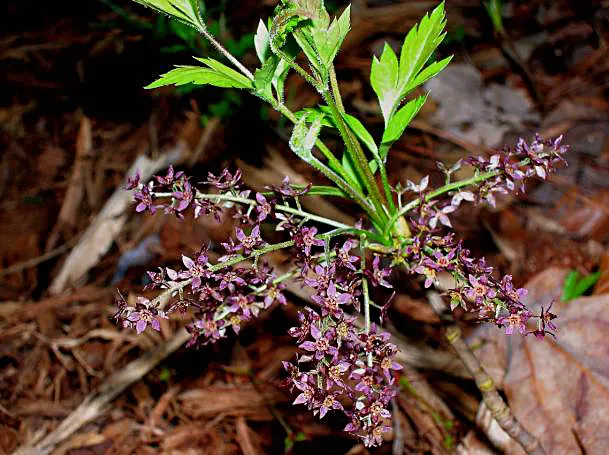
Photo: TheAlphaWolf, CC BY-SA 3.0 (via Wikimedia Commons)
Yellowroot
Xanthorhiza simplicissima
Also known as Shrub yellowroot, Carolina yellowroot, Yellow root
Key benefits
✦Traditional uses
✦Long before it found its way into ornamental woodland gardens, yellowroot was dug by Cherokee, Catawba, and other Appalachian communities, who prized the brilliant yellow root and inner bark as a bitter tonic. It was traditionally chewed or steeped as a gargle for sore throats and mouth sores, and taken as a digestive bitter to rouse a sluggish appetite. Because it shares berberine, the compound that gives goldenseal its punch, mountain herbalists often turned to yellowroot as a more abundant stand-in when goldenseal grew scarce from overharvesting. The same golden root also found its way into dye pots, lending wool and cloth a soft mustard hue.
How to grow & use it
✦The full apothecary for Yellowroot
Traditional remedies and step-by-step preparations, a complete growing guide, and how to harvest, dry, and store it, all unlocked with HerbLens Unlimited.
- ✦Remedies & preparations
- ✦ Growing guide
- ✦Harvest & storage
From under $6 a month. Free plant identifications always included.
- ✦Oregon grape root
- ✦Ginger
- ✦Licorice root
- ✦Goldenseal
- ✦Oregon grape root
“For the woodland tonic whose roots glow gold the moment you snap them.”
The buttercup family that yellowroot belongs to is made up almost entirely of soft-stemmed perennials, which makes yellowroot a genuine oddity: one of the very few truly woody shrubs in the whole Ranunculaceae clan.
Yellowroot's berberine content brings the same cautions as goldenseal or barberry: avoid it during pregnancy and breastfeeding, and don't give it to infants or young children. It can interact with blood thinners, blood pressure medications, and blood sugar medications, and is traditionally used only for short stretches.