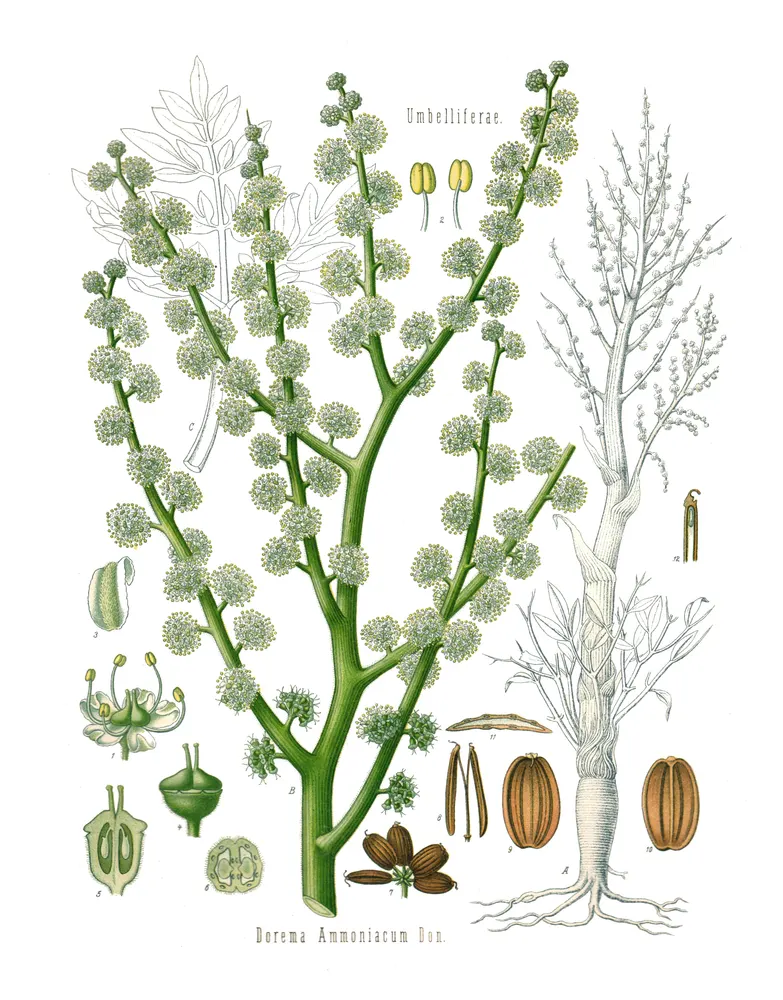
Photo: Unknown authorUnknown author, Public domain (via Wikimedia Commons)
Ammoniacum
Dorema ammoniacum
Also known as Gum Ammoniac, Ushak, Persian Ammoniacum, Ammoniac Gum
Key benefits
✦Traditional uses
✦Ammoniacum has been gathered from the deserts of Persia and Central Asia for thousands of years, prized as one of the great resins of old-world medicine. Physicians of the Unani and classical Greco-Roman traditions valued it as a warming expectorant, given for the lingering coughs and tight chests of chronic bronchitis and asthma, and it later found a settled place in Western pharmacopoeias for the very same purpose. Beyond the sickroom, the softened resin was worked into plasters and laid over stiff joints and swellings, a humble poultice passed down through generations of desert and village healers. Traders also carried it into the perfumer's and incense-maker's workshop, where its warm, musky smoke had its own devoted following.
Growing guide
✦Fresh to dried
✦Traditional preparations
✦Ammoniacum Warm Milk Decoction
A traditional preparation for a tight, congested chest, taken the way village herbalists once offered it, warm and sweetened.
How it's made. Traditionally, a small piece of the gum resin, about 1/2 teaspoon once crushed, is stirred into a cup of warm milk or water and sweetened with a little honey, taken once daily as needed.
Softened Resin Plaster
An old external application for stiff or swollen joints.
How it's made. The resin is gently warmed until pliable, spread thinly onto a clean cloth, and laid over the affected joint for a short time, then removed.
- ✦Licorice root
- ✦Thyme
- ✦Elecampane
- ✦Myrrh
- ✦Asafoetida
“For the deep, warming resin the desert gives to a heavy chest.”
The name ammoniacum traces back to the ancient oasis of Ammonium in the Libyan desert, where classical writers claimed the resin was first collected near a temple to the god Jupiter Ammon, and the name simply traveled west with the trade caravans.
As a member of the carrot family, ammoniacum may cause cross-reactions in people allergic to celery, carrot, or fennel, and it is best avoided during pregnancy and breastfeeding.