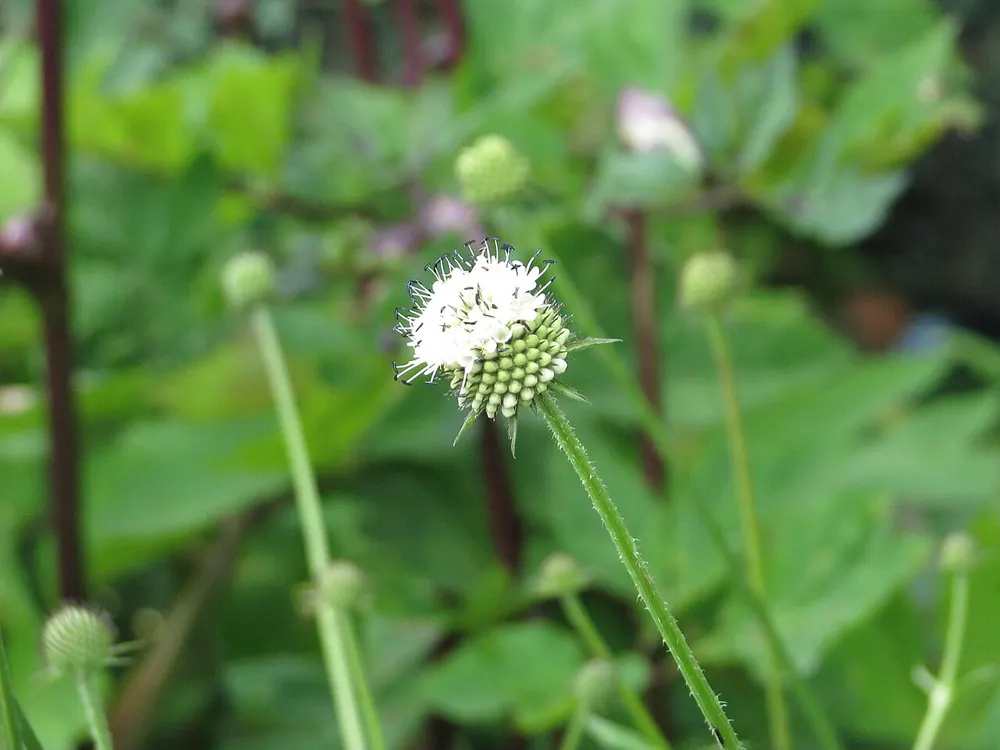
Photo: peganum from Henfield, England, CC BY-SA 2.0 (via Wikimedia Commons)
Japanese Teasel
Dipsacus asper
Also known as Himalayan Teasel, Xu Duan (Chinese: 续断), Rough Teasel, Nepal Teasel
Key benefits
✦Traditional uses
✦Known in Traditional Chinese Medicine as Xu Duan, meaning roughly 'restore what is broken,' this root has been used for well over a thousand years to help mend fractures, sprains, and torn sinews, and to steady an aching low back and weak knees. Practitioners traditionally paired it with other roots to nourish what TCM calls the Liver and Kidney systems, the organs thought to govern bone, tendon, and reproductive strength. It also holds a long-standing place in traditional women's health formulas, where it was used to support the lower back and pelvis during and after pregnancy. In the villages of its native mountain ranges, the freshly dug root was simply simmered into a warming, earthy broth for anyone recovering from a fall or a hard season of labor in the fields.
How to grow & use it
✦The full apothecary for Japanese Teasel
Traditional remedies and step-by-step preparations, a complete growing guide, and how to harvest, dry, and store it, all unlocked with HerbLens Unlimited.
- ✦Remedies & preparations
- ✦ Growing guide
- ✦Harvest & storage
From under $6 a month. Free plant identifications always included.
- ✦Eucommia bark (Du Zhong)
- ✦Chinese Angelica (Dang Gui)
- ✦Achyranthes root (Niu Xi)
- ✦Common Teasel root (Dipsacus fullonum)
- ✦Eucommia bark (Du Zhong)
“For the deep, mending work of a weary low back and hard-worked joints.”
The Chinese name for this root, Xu Duan, translates to something like 'reconnect the broken,' a name so literal that herbalists have used it for centuries specifically for mending fractures and torn tendons.
Japanese teasel's effect on blood clotting and hormone-sensitive conditions is not well understood, so use caution with blood thinners or hormone medication. It has a traditional association with pregnancy and should only be used then under a qualified TCM practitioner's guidance.