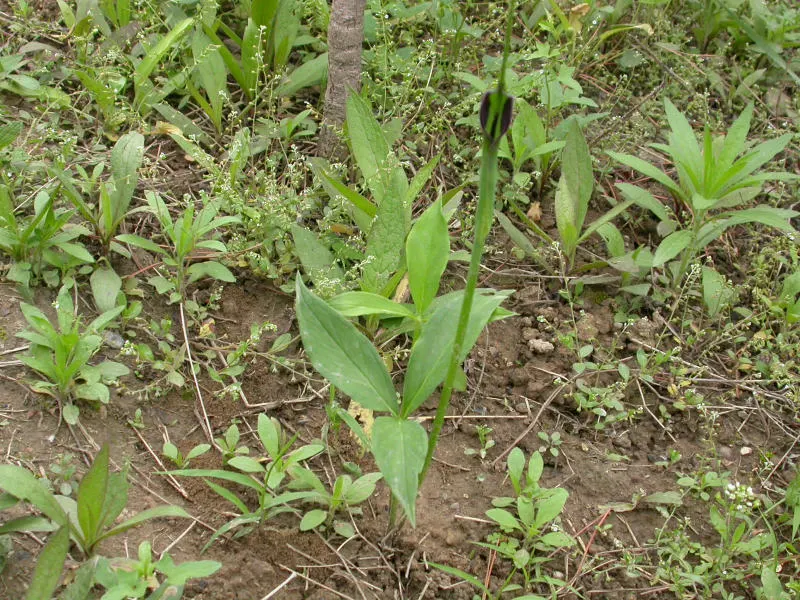
Photo: The original uploader was Polyhedron at Chinese Wikipedia., CC BY-SA 3.0 (via Wikimedia Commons)
Crow Dipper
Pinellia ternata
Also known as Ban Xia, Crow Dipper, Half Summer, Green Arrow Arum's Cousin
Traditional uses
✦In Chinese herbal medicine, the processed corm of Pinellia ternata, known as Ban Xia, has a long history stretching back to some of the earliest surviving pharmacopoeias, where it appears among the classic formulas for settling the stomach and transforming phlegm. Practitioners traditionally reserved it for qualified, formal preparation rather than home use, precisely because the raw plant is so irritating. Its name, meaning half summer, refers to the point in the growing season, around the summer solstice, when the corms were traditionally thought best to harvest. It remains one of the more storied and carefully handled roots in the traditional Chinese herbal cabinet.
How to grow & use it
✦The full apothecary for Crow Dipper
Traditional remedies and step-by-step preparations, a complete growing guide, and how to harvest, dry, and store it, all unlocked with HerbLens Unlimited.
- ✦Remedies & preparations
- ✦ Growing guide
- ✦Harvest & storage
From under $6 a month. Free plant identifications always included.
- ✦Ginger
- ✦Citrus peel
- ✦Poria mushroom
- ✦Ginger (for settling the stomach in home herbalism)
- ✦Fennel (for mild digestive discomfort)
“A plant to admire in the shade garden and respect from a careful distance, not one to gather by hand.”
Pinellia ternata is sometimes nicknamed the three-leaved arum for its distinctive trio of leaflets, and its small hooded flowers, with a slender whip-like spadix tip, mark it clearly as a member of the same botanical family as jack-in-the-pulpit and calla lily, both known for similar irritant compounds in their raw tissues.
Pinellia ternata is toxic in its raw, unprocessed state. The fresh corm contains needle-like calcium oxalate crystals and irritant compounds that cause immediate, intense burning of the mouth, throat, and tongue, along with swelling that can affect breathing and swallowing if chewed or swallowed raw. In its home of Chinese herbal medicine it is never used fresh. It is only rendered usable after lengthy, specialized processing, repeated soaking, curing with ginger, alum, or lime, and controlled heat treatment, carried out by trained practitioners, and even then it is generally reserved for professional formulation rather than home use. It should not be foraged, chewed, or self-prepared under any circumstances, and is considered unsafe in pregnancy. Handling the raw plant can also irritate skin. For these reasons no home remedies or preparations are given here. Anyone interested in this herb's traditional applications should consult a licensed practitioner of Chinese herbal medicine, and never attempt to process or ingest the raw corm at home.