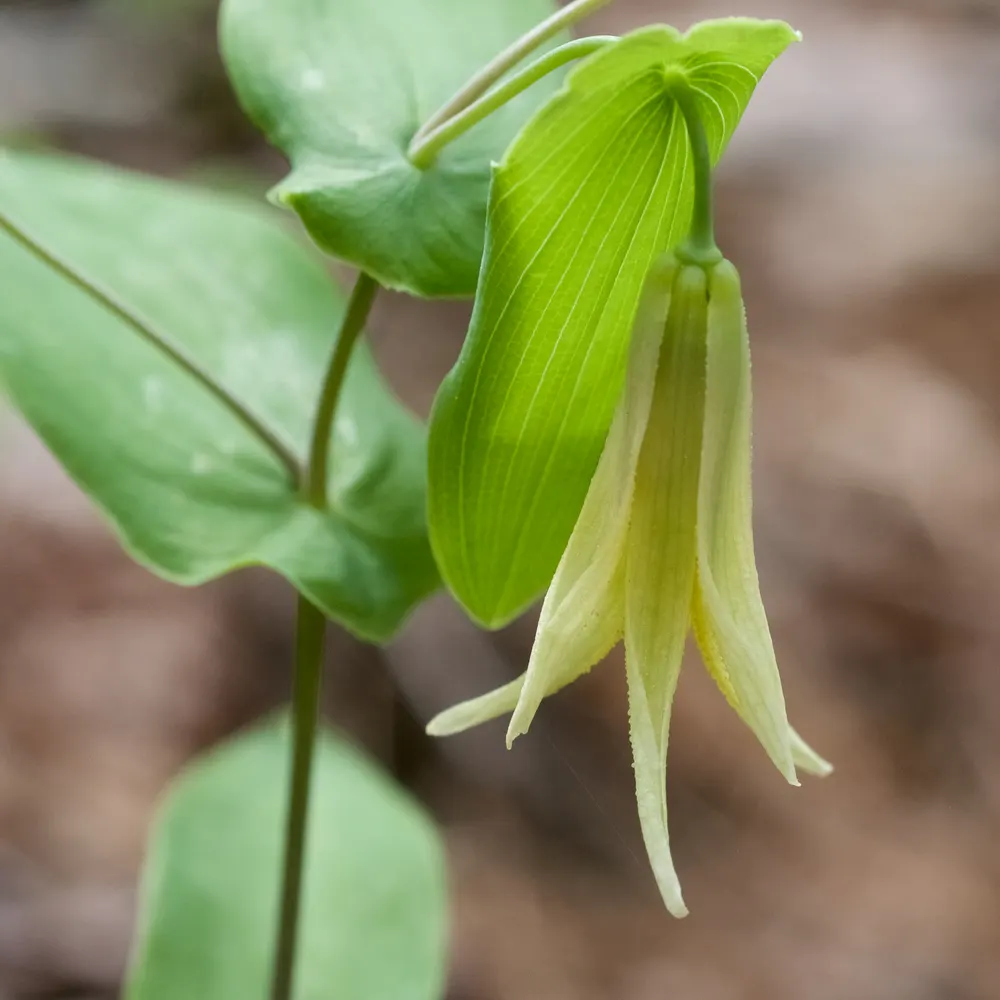
Photo: Eric Hunt, CC BY-SA 4.0 (via Wikimedia Commons)
Perfoliate Bellwort
Uvularia perfoliata
Also known as Perfoliate Merrybells, Mealy Bellwort, Little Merrybells, Strawbell
Key benefits
✦Traditional uses
✦Long before it was a shade-garden favorite, perfoliate bellwort grew quietly in the leaf litter of eastern forests, where it caught the attention of the Cherokee and other Native peoples who lived alongside it. Root preparations were traditionally used as a wash or poultice for cuts, bruises, and boils, and a root infusion was sometimes taken for sore throats and coughs. The tender young shoots, which push up through the forest duff each spring bearing a faint resemblance to wild asparagus, were also traditionally gathered and eaten as an early season green. It has never been a headline herb of Western herbalism, but in the hollows where it grows, it has quietly earned its keep for generations.
How to grow & use it
✦The full apothecary for Perfoliate Bellwort
Traditional remedies and step-by-step preparations, a complete growing guide, and how to harvest, dry, and store it, all unlocked with HerbLens Unlimited.
- ✦Remedies & preparations
- ✦ Growing guide
- ✦Harvest & storage
From under $6 a month. Free plant identifications always included.
- ✦Solomon's seal
- ✦Wild ginger
- ✦Slippery elm
- ✦Solomon's seal root
“For the hushed, dappled quiet of a spring forest floor, where pale bells nod before the canopy has fully closed overhead.”
The plant's odd botanical name comes from its leaves, which appear to be skewered straight through by the stem, a rare growth habit botanists call perfoliate, as if each leaf were a small green collar strung along the stalk.
Not known to be significantly toxic, but it hasn't been well studied for internal use, so it shouldn't be treated as a proven remedy. Woodland look-alikes can be genuinely dangerous, so take care with identification.