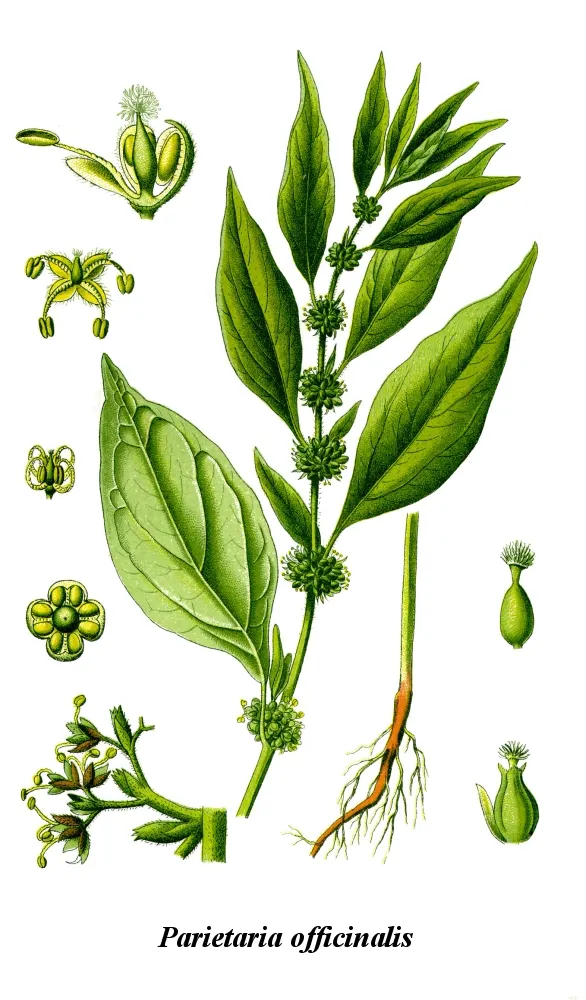
Photo: User:Chrizz, CC BY-SA 3.0 (via Wikimedia Commons)
Pellitory-of-the-wall
Parietaria officinalis
Also known as Wall Pellitory, Lichwort, Spreading Pellitory, Paritary
Key benefits
✦Traditional uses
✦Pellitory-of-the-wall has quietly kept company with human settlements for thousands of years, rooting itself into the mortar of old walls, cottages, and ruins across Europe. Ancient and medieval herbalists, including Pliny the Elder, praised it as a gentle remedy for gravel and stone, and it earned a steady place in folk medicine as a soothing diuretic herb for the urinary tract. Country healers also bruised the fresh leaves into a cooling poultice for minor burns, stings, and irritated skin, and brewed the leaf into a mild tea for coughs and sore throats. It never became a famous herb, but it was a reliably present one, growing wherever old walls offered it a foothold.
How to grow & use it
✦The full apothecary for Pellitory-of-the-wall
Traditional remedies and step-by-step preparations, a complete growing guide, and how to harvest, dry, and store it, all unlocked with HerbLens Unlimited.
- ✦Remedies & preparations
- ✦ Growing guide
- ✦Harvest & storage
From under $6 a month. Free plant identifications always included.
- ✦Nettle
- ✦Cleavers
- ✦Dandelion Leaf
- ✦Cleavers
- ✦Corn Silk
“When the crumbling wall at the edge of the garden turns out to be growing something useful.”
Pellitory-of-the-wall is entirely unrelated to Spanish pellitory (Anacyclus pyrethrum), a daisy-family plant used historically for toothache, despite the two sharing a common name. Wall pellitory earned its name simply from its habit of rooting into the mortar and stonework of old walls, exactly where Roman and medieval herbalists most often found it growing.
Its fine pollen is a major cause of hay fever in Mediterranean regions, so those with pollen allergies or asthma should be cautious around the flowering plant. As a diuretic herb, use caution with kidney disease or diuretic medications.