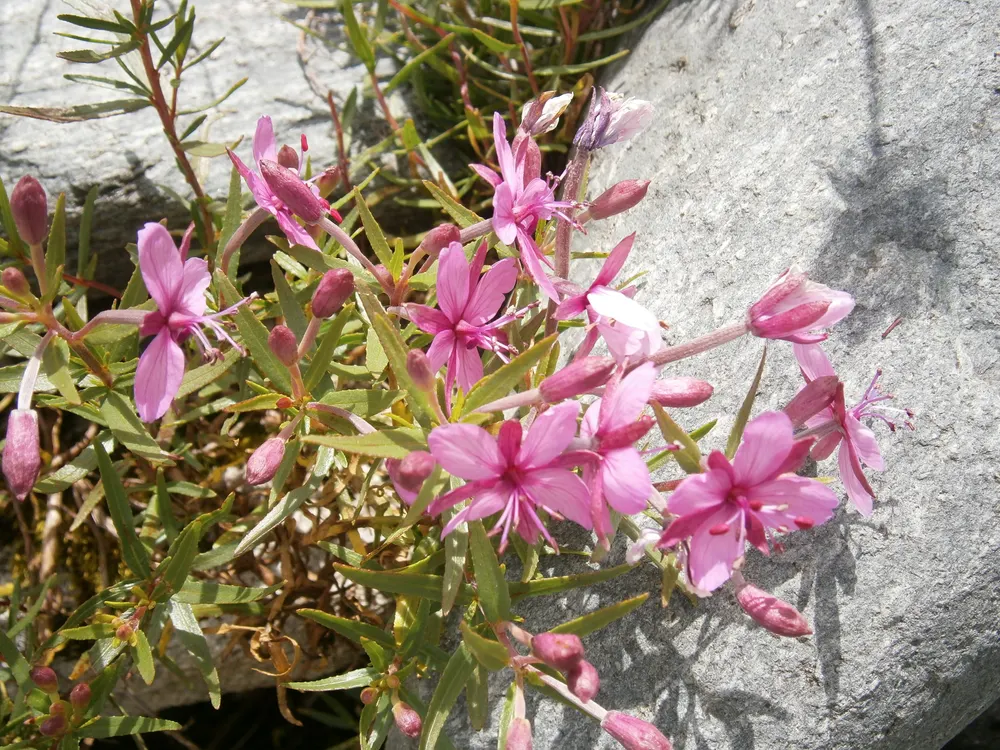
Photo: Meneerke bloem, CC BY-SA 3.0 (via Wikimedia Commons)
Fleischer's Willowherb
Epilobium fleischeri
Also known as Alpine Willowherb, Glacier Willowherb, Fleischer's Rosebay Willowherb
Key benefits
✦Traditional uses
✦Fleischer's willowherb is not a plant with a documented history in traditional herbal medicine the way its lowland cousins are. Instead, its story belongs to botany and mountaineering lore, it is one of the very first flowering plants to take hold on raw, freshly exposed glacial moraine, often arriving within a decade or two of the ice retreating. Alpine botanists and hikers have long prized it as a hopeful sign of life returning to ground that was recently locked under ice, and rock gardeners have grown it for well over a century for the way its silvery, gravel-loving mats erupt into sheets of pink-violet bloom.
How to grow & use it
✦The full apothecary for Fleischer's Willowherb
Traditional remedies and step-by-step preparations, a complete growing guide, and how to harvest, dry, and store it, all unlocked with HerbLens Unlimited.
- ✦Remedies & preparations
- ✦ Growing guide
- ✦Harvest & storage
From under $6 a month. Free plant identifications always included.
- ✦Moss campion (Silene acaulis)
- ✦Alpine saxifrage (Saxifraga species)
- ✦Alpine toadflax (Linaria alpina)
- ✦Rosebay willowherb (Epilobium angustifolium) for a related look in lowland gardens
- ✦Dodonaei willowherb (Epilobium dodonaei) for a similar scree-loving habit
“For the barest, coldest ground, the gravel a glacier only recently let go of, where almost nothing else has dared to grow yet.”
Botanists and glaciologists sometimes use Fleischer's willowherb as a living clock. Because it is so often the first flowering plant to root in bare moraine, the size and density of its colonies can help estimate how many years it has been since a patch of ground last lay under glacial ice.
Fleischer's willowherb isn't known to be toxic, but it has no established medicinal use and often grows in protected alpine habitats, so it's best left undisturbed rather than picked.