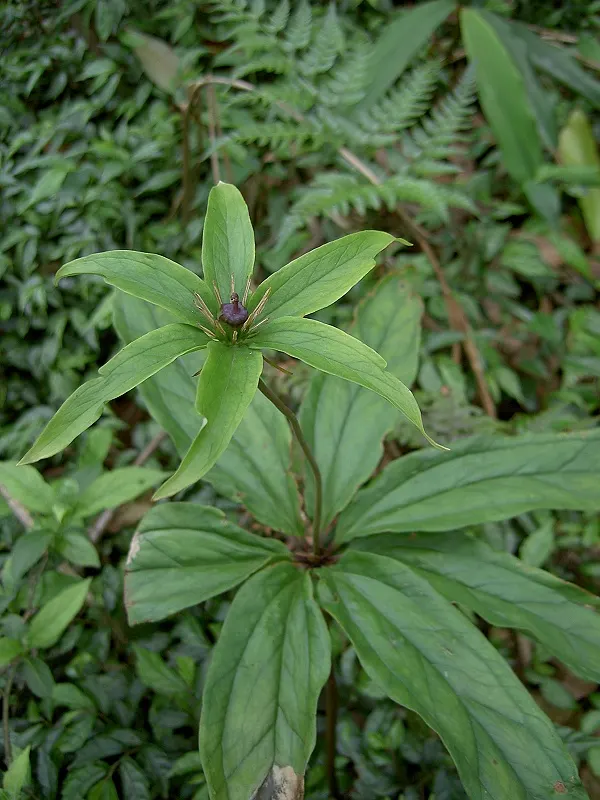
Photo: Alnus, CC BY-SA 3.0 (via Wikimedia Commons)
Love Apple
Paris polyphylla
Also known as Chong Lou, Zao Xiu, Qi Ye Yi Zhi Hua (Seven Leaves One Flower), Paris Root, Himalayan Paris
Key benefits
✦Traditional uses
✦Deep in the understory forests of the Himalayas and Yunnan, this quiet, whorl-leaved plant became one of the most trusted rhizomes in Traditional Chinese Medicine, where it is known as Chong Lou or Zao Xiu. Healers traditionally turned to the carefully processed rhizome to clear heat and toxins from the body, to calm swelling, and to tend snakebites and boils, and it became a key ingredient in the celebrated patent formula Yunnan Baiyao. Its odd architecture, a single ring of leaves holding up one strange starry flower, made it easy to recognize in the wild and easy to remember in the old herbals. Because the raw rhizome is toxic, its traditional use was always the work of skilled practitioners, never a home remedy.
How to grow & use it
✦The full apothecary for Love Apple
Traditional remedies and step-by-step preparations, a complete growing guide, and how to harvest, dry, and store it, all unlocked with HerbLens Unlimited.
- ✦Remedies & preparations
- ✦ Growing guide
- ✦Harvest & storage
From under $6 a month. Free plant identifications always included.
- ✦Isatis root (Ban Lan Gen)
- ✦Forsythia (Lian Qiao)
- ✦Scutellaria (Huang Qin)
- ✦Isatis root (Ban Lan Gen), for traditional heat-clearing formulas
- ✦Houttuynia, for traditional detoxifying use
“For the quiet architecture of a shaded woodland corner, a single starry flower held aloft on a ring of leaves, admired, never gathered.”
The plant's Chinese name, Qi Ye Yi Zhi Hua, means 'seven leaves, one flower,' describing the way a single whorl of leaves cradles one lone blossom, and its small red berry-like fruit is likely why English speakers gave it the folk name love apple, the very same nickname once given to the tomato.
Paris polyphylla is a genuinely toxic plant, and this entry intentionally includes no home preparations. The rhizome contains steroidal saponins (polyphyllins) that are cytotoxic and can cause severe nausea, vomiting, diarrhea, and other serious symptoms if eaten raw, in excess, or without proper processing. In its traditional range it was only ever used by trained Traditional Chinese Medicine practitioners as one carefully processed and precisely dosed component of compound formulas, never taken on its own or prepared at home. The plant is also increasingly vulnerable in the wild due to overharvesting, so it should be admired in the garden or in habitat rather than collected. Do not ingest any part of this plant. If you are drawn to its traditional medicinal history, please speak with a qualified, licensed TCM practitioner or healthcare provider rather than attempting any preparation yourself.