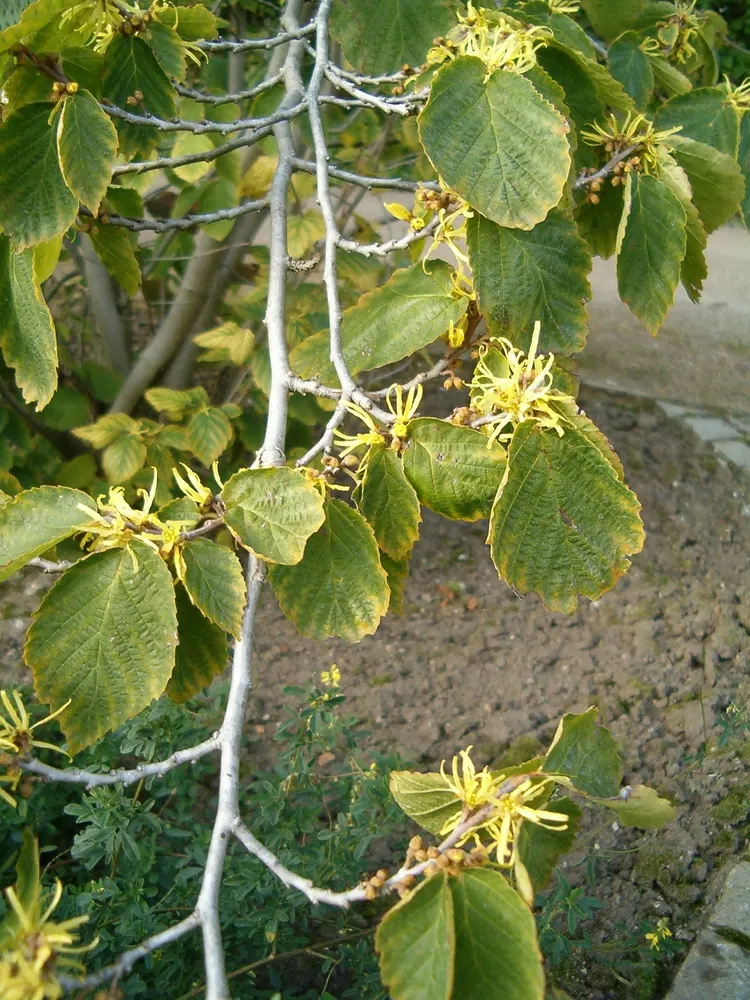
Photo: CC BY-SA 3.0 (via Wikimedia Commons)
Witch Hazel
Hamamelis virginiana
Also known as Winterbloom, Spotted Alder, Snapping Hazel, Witch Hazel Water
Key benefits
✦Traditional uses
✦Long before it sat in a blue bottle on a bathroom shelf, witch hazel was a trusted plant among the Osage, Potawatomi, Iroquois, and other Native American nations, who simmered its bark and twigs into decoctions for wounds, bruises, insect bites, and sore, tired skin. Early colonists learned the plant's uses from Native neighbors, and by the 1800s, distilled witch hazel water had become a fixture of the American medicine cabinet, made most famous by the Dickinson family of Essex, Connecticut. Its cooling, tightening touch on the skin made it a household remedy passed down for generations, one of the few truly homegrown American herbal traditions.
How to grow & use it
✦The full apothecary for Witch Hazel
Traditional remedies and step-by-step preparations, a complete growing guide, and how to harvest, dry, and store it, all unlocked with HerbLens Unlimited.
- ✦Remedies & preparations
- ✦ Growing guide
- ✦Harvest & storage
From under $6 a month. Free plant identifications always included.
- ✦Calendula
- ✦Chamomile
- ✦Aloe Vera
- ✦Rose Water
- ✦Chamomile Tea
“When the skin asks for a cool, quiet hand.”
Witch hazel branches were traditionally cut and used as dowsing rods, or 'witching sticks,' to search for underground water. This practice, not any connection to sorcery, is thought to be the true source of the 'witch' in its name, likely from the Old English 'wice,' meaning pliant or bendable.
Witch hazel is generally safe used externally as directed, though its tannins can irritate in concentrated form, so patch test first. Commercial distilled witch hazel water often contains alcohol and is for external use only, kept away from eyes and broken skin. Stronger bark preparations aren't taken internally in modern practice and may cause stomach upset.