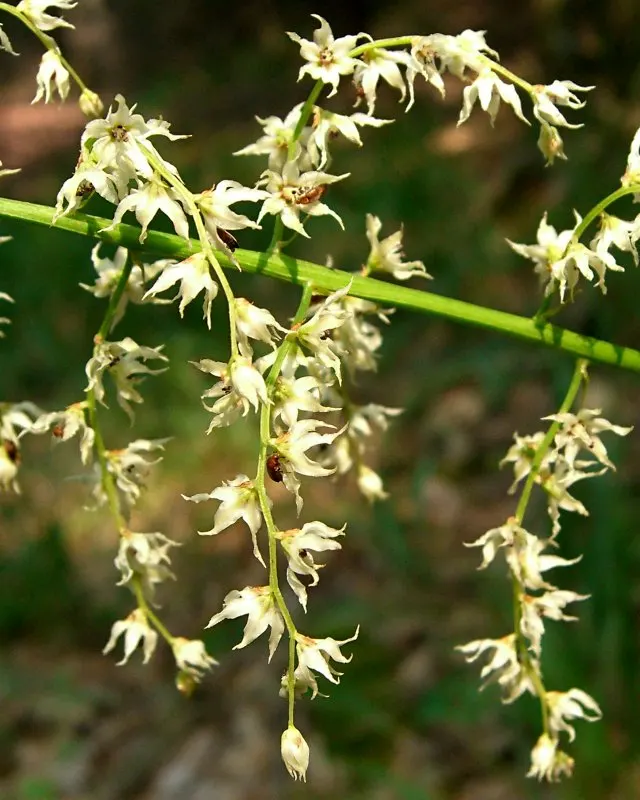
Photo: pellaea, CC BY 2.0 (via Wikimedia Commons)
Featherbells
Stenanthium gramineum
Also known as Eastern Featherbells, Grassy Featherbells, Devil's Bit
Key benefits
✦Traditional uses
✦Featherbells has no real tradition as a medicine or a foodstuff. Rural communities and old-time herbalists in its Appalachian and southeastern range knew it chiefly as a plant to leave alone, a tall cousin of the death camas and false hellebore that quietly stood in wet meadows and open woods. Farmers learned early to watch their grazing stock around it, since a mouthful of the wrong bulb among the pasture grasses could sicken an animal. What value it held was mostly in the noticing, a signpost of a healthy damp meadow and a reminder that not every graceful bloom is a friendly one.
How to grow & use it
✦The full apothecary for Featherbells
Traditional remedies and step-by-step preparations, a complete growing guide, and how to harvest, dry, and store it, all unlocked with HerbLens Unlimited.
- ✦Remedies & preparations
- ✦ Growing guide
- ✦Harvest & storage
From under $6 a month. Free plant identifications always included.
“For the pale, feathery plume rising over a damp summer meadow, best admired from a respectful distance and never picked for the table.”
Featherbells belongs to the same family, Melanthiaceae, as death camas and false hellebore (Veratrum), and it carries the same family trait of steroidal alkaloids in its tissue. Botanists sometimes use that toxic chemistry as a clue when sorting out confusing look-alike lilies in the field, since the innocent white blossoms give no visual warning at all.
Featherbells (Stenanthium gramineum) is a toxic plant. Like its relatives death camas and false hellebore, it contains steroidal alkaloids concentrated in the bulb but present throughout the plant, and ingestion by people or livestock can cause nausea, vomiting, drooling, weakness, a dangerously slowed heartbeat, and lowered blood pressure, with severe cases posing a real risk to life. There is no safe traditional dose and this entry gives none. Keep it out of reach of children, pets, and grazing animals, never confuse the bulb with edible wild alliums or camas, and if ingestion is suspected treat it as an emergency and contact poison control or seek medical care right away. As always, speak with a qualified healthcare professional or a regional poison control center before assuming any wild plant is safe.