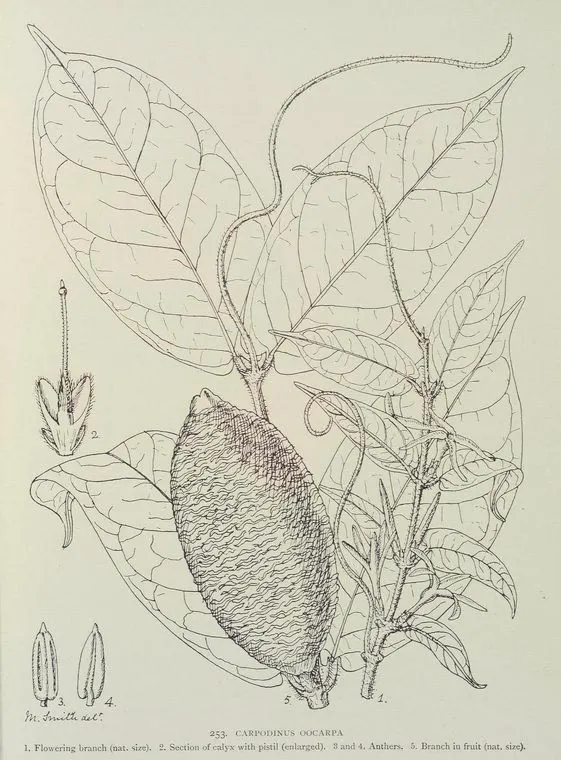
Photo: Matilda Smith (died 1926), Public domain (via Wikimedia Commons)
Sweet Landolphia
Landolphia dulcis
Also known as Sweet rubber vine, Landolphia fruit
Key benefits
✦Traditional uses
✦For generations, forest communities have gathered the ripe fruits of Landolphia dulcis for their sweet, tangy pulp, eating them straight off the vine or carrying handfuls home as a trailside treat. Like many of its Landolphia relatives, this liana produces a milky latex that was once tapped and traded as a source of wild African rubber, before cultivated Hevea plantations took over the world market in the early twentieth century. Beyond its fruit, the vine has simply been valued for its presence at the forest edge, offering something sweet to eat during seasons when little else was ripe.
How to grow & use it
✦The full apothecary for Sweet Landolphia
Traditional remedies and step-by-step preparations, a complete growing guide, and how to harvest, dry, and store it, all unlocked with HerbLens Unlimited.
- ✦Remedies & preparations
- ✦ Growing guide
- ✦Harvest & storage
From under $6 a month. Free plant identifications always included.
- ✦Tamarind
- ✦Wild honey
- ✦Baobab fruit
- ✦Tamarind pulp
- ✦Passion fruit
“For the sweet surprise waiting at the forest's edge, where a heavy-hanging landolphia vine offers up its fruit to whoever finds it first.”
Landolphia vines were once so central to Africa's rubber trade that entire forest economies grew up around tapping their latex, long before rubber plantations in Southeast Asia and Brazil made wild-harvested vine rubber a thing of the past.
As a member of the dogbane family, this plant has milky latex that can irritate skin and mucous membranes, so only the fully ripe fruit is traditionally eaten; avoid unripe fruit, seeds, and raw sap. Confirm identification carefully, since look-alike forest vines exist.