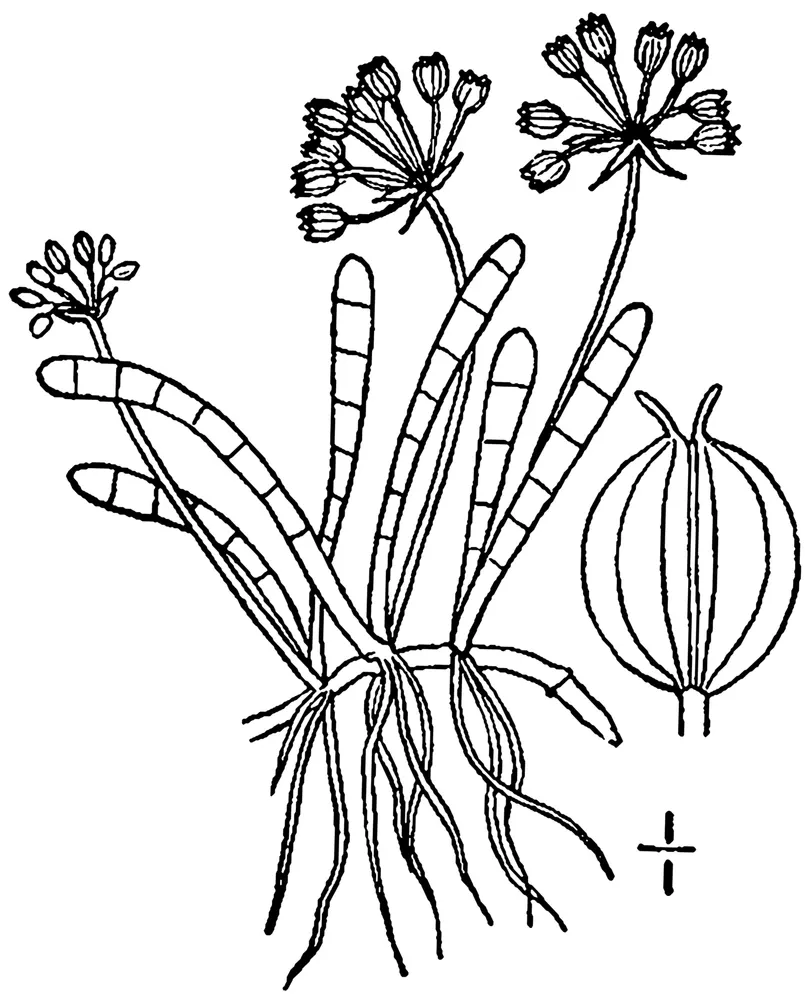
Photo: Britton, N.L., and A. Brown. 1913. An illustrated flora of the northern United States, Canada and the British Possessions. 3 vols. Charles Scribner's Sons, New York. Vol. 2: 648. Courtesy of Kentucky Native Plant Society. Scanned by Omnitek Inc., Public domain (via Wikimedia Commons)
Eastern Lilaeopsis
Lilaeopsis chinensis
Also known as Eastern grasswort, Grasswort, Eastern lilaeopsis, Micro sword grass
Key benefits
✦Traditional uses
✦Eastern Lilaeopsis has no documented history as a medicinal or culinary herb, and none is claimed here. Its real story is a quieter one: for generations it has simply been part of the marsh itself, a low green turf holding the mud together where the tide comes and goes twice a day. Coastal restoration projects still lean on it for exactly that reason, and in more recent decades aquarium keepers discovered the same wiry little plant makes a beautiful, hardy carpet underwater. It is a plant valued for what it does in a landscape, not for what can be brewed from it.
How to grow & use it
✦The full apothecary for Eastern Lilaeopsis
Traditional remedies and step-by-step preparations, a complete growing guide, and how to harvest, dry, and store it, all unlocked with HerbLens Unlimited.
- ✦Remedies & preparations
- ✦ Growing guide
- ✦Harvest & storage
From under $6 a month. Free plant identifications always included.
- ✦Dwarf hairgrass (Eriocaulon or Eleocharis species)
- ✦Saltmarsh cordgrass (Spartina)
- ✦Water clover (Marsilea)
- ✦Dwarf hairgrass (Eleocharis parvula)
- ✦Marsilea minuta
“For the muddy, tide-washed edge where nothing else will hold, and for the aquarium foreground that wants to look like a tiny green meadow.”
Despite looking like a tuft of grass, Lilaeopsis chinensis is a true member of the carrot and parsley family. What looks like a blade of grass is not a leaf at all but a hollow, cross-partitioned leaf stalk, an odd bit of botanical disguise that lets the plant breathe and flex as the tide pulls at it twice a day.
Eastern Lilaeopsis has no history of food or medicinal use and no safety data, so it should not be eaten. It grows in tidal marshes that can carry contaminants, so treat it as a garden and aquascaping plant only.