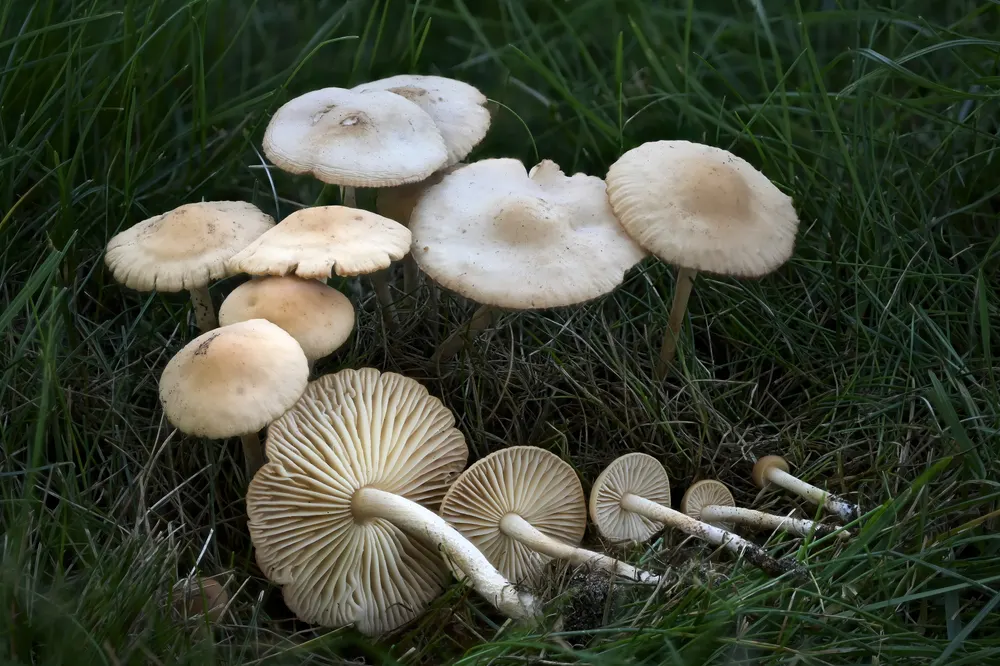
Photo: Alan Rockefeller, CC BY 4.0 (via Wikimedia Commons)
Fairy Ring Mushroom
Marasmius oreades
Also known as Scotch Bonnet, Fairy Ring Champignon, Mousseron
Key benefits
✦Traditional uses
✦Long before anyone called it umami, cooks across the British Isles and continental Europe were threading these little caps onto string to dry over the hearth, prizing them for a flavor far bigger than their size suggests. The mushroom's true fame, though, comes from the ground it grows on. The dark green arcs and full circles it leaves behind in old pastures and village greens were, for centuries, read as the dance floors of fairies, and finding one was met with equal parts wonder and caution. Country folk generally left the rings undisturbed, believing it unlucky to plow through fairy ground, even as they happily gathered the mushrooms growing along its edge. This entry covers a wild fungus rather than an herb, so it belongs in the kitchen and the meadow rather than the medicine cabinet.
How to grow & use it
✦The full apothecary for Fairy Ring Mushroom
Traditional remedies and step-by-step preparations, a complete growing guide, and how to harvest, dry, and store it, all unlocked with HerbLens Unlimited.
- ✦Remedies & preparations
- ✦ Growing guide
- ✦Harvest & storage
From under $6 a month. Free plant identifications always included.
- ✦Thyme
- ✦Parsley
- ✦Garlic
- ✦Dried button mushroom
- ✦Dried shiitake
“For the dried mushroom that turns an ordinary broth into something that tastes like autumn rain on an old meadow.”
Some fairy rings in old English pastures have been growing outward, a little farther every year, for centuries. A few documented rings are estimated to be several hundred years old, quietly widening long after everyone who first noticed them is gone.
Fairy ring mushroom has dangerous look-alikes, including small white Clitocybe species that cause serious, sometimes fatal, poisoning if mistaken for it. Never eat this or any wild mushroom unless identified with certainty by an expert.