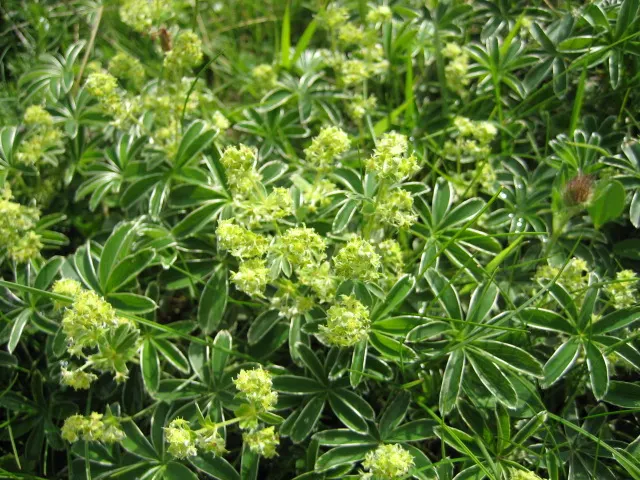
Photo: Rémih, CC BY-SA 3.0 (via Wikimedia Commons)
Alpine Lady's Mantle
Alchemilla alpina
Also known as Mountain Lady's Mantle, Alpine Alchemilla, Silver Lady's Mantle
Key benefits
✦Traditional uses
✦Alchemilla alpina has long gone by the name lady's mantle in the herbal tradition, a name given for the way its scalloped, silver-backed leaves gather morning dew into a single shining bead, said to resemble a cloak folded around the shoulders of the Virgin Mary. In the mountain communities of Europe, herbalists traditionally turned to its leaves as a woman's herb, brewing infusions believed to ease the discomforts of the monthly cycle and to support recovery in the weeks after childbirth. It was also kept as a humble household astringent, its cooled tea dabbed onto small cuts and scrapes, and sipped warm to settle a queasy stomach.
Growing guide
✦Fresh to dried
✦Traditional preparations
✦Traditional Lady's Mantle Tea
A gentle infusion traditionally sipped to support women's health and ease digestive discomfort.
How it's made. Traditionally, a tea is made by steeping 1 teaspoon of the dried leaf in 250 ml of just-boiled water for 10 minutes, then strained and sipped up to twice daily.
Cooled Leaf Wash
A mild astringent wash traditionally dabbed onto minor cuts and scrapes to help keep the area clean.
How it's made. Steep 1 teaspoon of dried leaf in 250 ml of just-boiled water for 10 minutes, let cool completely, then apply to the skin with a clean cloth.
- ✦Raspberry leaf
- ✦Nettle
- ✦Yarrow
- ✦Alchemilla vulgaris (common lady's mantle)
- ✦Yarrow
“For the small silvery herb of the high slopes, traditionally steeped to ease and restore.”
The genus name Alchemilla comes from the word alchemy. Medieval alchemists prized the perfectly round dew droplets that collect on the leaf's tiny hairs each morning, believing this water, gathered from something so close to the heavens, held a special purity fit for their experiments in transforming base metal into gold.
Alpine Lady's Mantle has no significant toxicity when used as a mild traditional tea. Because of its long association with the reproductive cycle, it has traditionally been avoided during pregnancy.