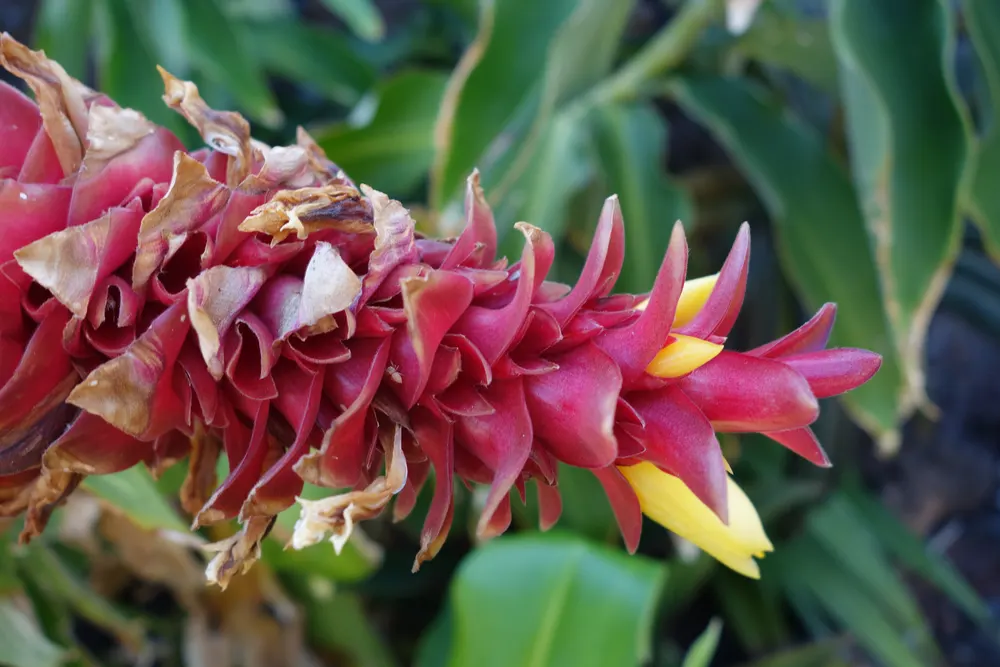
Photo: Relativity, CC BY-SA 4.0 (via Wikimedia Commons)
Spiral Ginger
Costus barbatus
Also known as Red Button Ginger, Scarlet Spiral Flag, Spiral Flag Ginger
Key benefits
✦Traditional uses
✦Spiral ginger belongs to a family long woven into the daily life of Central American forest communities, where the fleshy, faintly sour stems of various Costus species have been chewed for casual thirst relief on long walks, much the way a hiker today might reach for a water bottle. Costus barbatus itself is less documented in traditional medicine than famous cousins like Costus igneus, the so called insulin plant, or Costus speciosus, and it has always been prized first and foremost for its beauty. Its true legacy is as a garden and understory plant, grown at forest edges and in dooryard gardens for the pleasure of its color and for the hummingbirds it never fails to summon.
How to grow & use it
✦The full apothecary for Spiral Ginger
Traditional remedies and step-by-step preparations, a complete growing guide, and how to harvest, dry, and store it, all unlocked with HerbLens Unlimited.
- ✦Remedies & preparations
- ✦ Growing guide
- ✦Harvest & storage
From under $6 a month. Free plant identifications always included.
- ✦Heliconia
- ✦Ginger lily (Hedychium)
- ✦Calathea
- ✦Costus speciosus
- ✦Cheilocostus lucanusianus
“When a shady corner of the garden needs a spark of tropical fire, and you want the hummingbirds to visit and stay.”
The whole spiral ginger family owes its common name to the way each new leaf twists slightly around the stem as it unfurls, spiraling the plant upward in a slow corkscrew. That single trait is the easiest way to tell a true Costus from a look-alike true ginger, whose leaves instead line up in two flat, opposite rows.
Spiral ginger has no established history of internal or medicinal use. Its sap can mildly irritate sensitive skin, so keep pets and children from chewing on it.