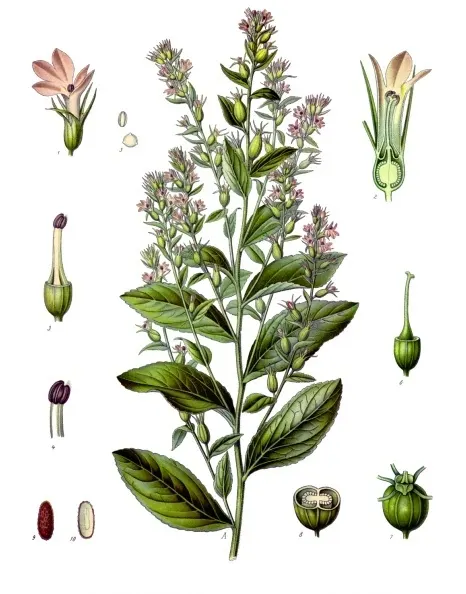
Photo: Franz Eugen Köhler, Köhler's Medizinal-Pflanzen, Public domain (via Wikimedia Commons)
Indian Tobacco
Lobelia inflata
Also known as Pukeweed, Asthma Weed, Vomit Wort, Wild Tobacco, Gagroot
Key benefits
✦Traditional uses
✦Indian Tobacco earned its name from Native American groups, including the Penobscot and other northeastern nations, who dried and smoked the leaves much as they did true tobacco, and passed knowledge of the plant to early European settlers. It became the signature herb of Samuel Thomson, the nineteenth-century American herbalist whose entire school of botanical medicine leaned on lobelia's powerful emetic action to "clear" the body, a practice that made the plant both famous and controversial in equal measure. Through the 1800s it was also smoked or brewed by folk healers as a treatment for asthma and whooping cough, giving rise to its old country name, asthma weed. Because its active alkaloids are unforgiving of overuse, lobelia's story is as much a caution about the limits of old-time medicine as it is a record of genuine traditional regard.
How to grow & use it
✦The full apothecary for Indian Tobacco
Traditional remedies and step-by-step preparations, a complete growing guide, and how to harvest, dry, and store it, all unlocked with HerbLens Unlimited.
- ✦Remedies & preparations
- ✦ Growing guide
- ✦Harvest & storage
From under $6 a month. Free plant identifications always included.
- ✦Cayenne (in historic Thomsonian formulas)
- ✦Mullein
- ✦Skullcap
- ✦Mullein (for gentler traditional respiratory support)
- ✦Elecampane
“A wildflower with a name that has been whispered as both remedy and warning for two hundred years.”
Samuel Thomson, the herbalist who built his entire nineteenth-century medical movement around this plant, was actually put on trial for manslaughter in 1809 after a patient died from a lobelia treatment. He was acquitted, but the case became one of early America's most famous fights over who had the right to practice medicine.
Lobelia inflata is toxic and must not be self-administered. It contains lobeline and related alkaloids that, taken beyond a trained practitioner's small, carefully judged doses, cause intense vomiting, profuse sweating, tremor, weakness, a rapid or irregular heartbeat, confusion, and in significant overdose, respiratory depression, collapse, and death; poisoning cases and fatalities are documented in the medical literature. It is unsafe in pregnancy and breastfeeding, and it can interact dangerously with heart medications, blood pressure drugs, and nicotine replacement products because of its nicotine-like action on the body. In 1993 the FDA banned lobeline from being sold in over-the-counter smoking-cessation products specifically because of safety concerns. This is not an herb for home use, tea, or casual foraging; any historical or clinical interest in it should be pursued only through a licensed physician or qualified herbalist, never on your own.