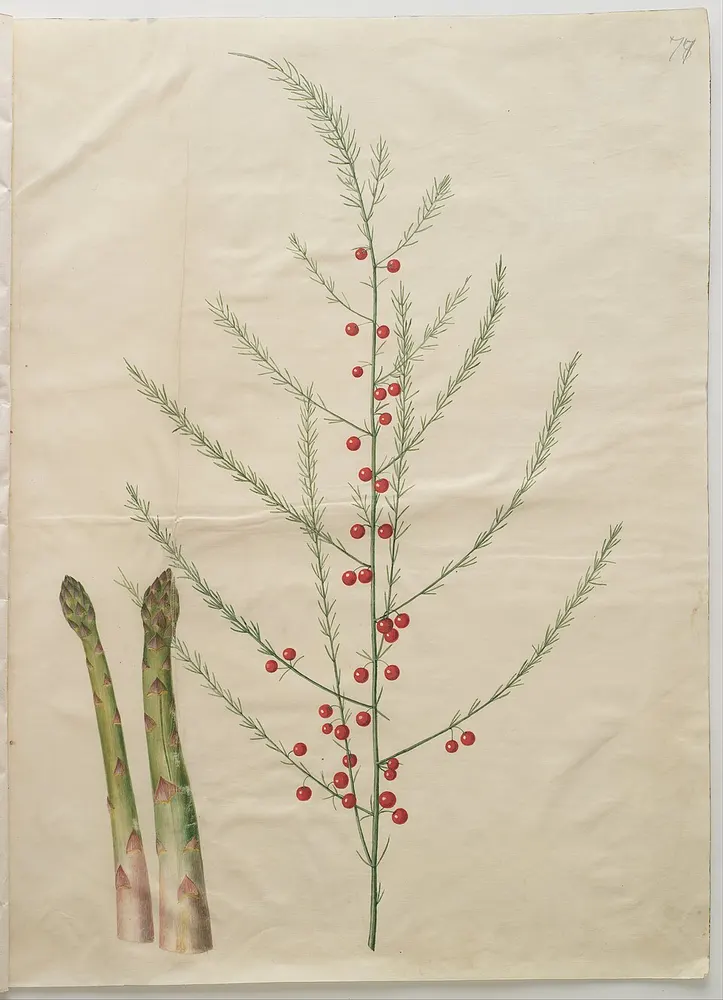
Photo: Hans Simon Holtzbecker, Public domain (via Wikimedia Commons)
Asparagus
Asparagus officinalis
Also known as Garden Asparagus, Sparrow Grass, Asparagus Fern (ornamental form)
Key benefits
✦Traditional uses
✦Asparagus has been prized since antiquity, with the Greeks and Romans cultivating it both as a delicacy and as a physic plant, and Roman cookbooks even gave instructions for growing spears as thick as a thumb. Across European folk medicine, a tea brewed from the root or the tougher stem ends was traditionally taken to encourage the kidneys to work and to help the body shed excess water, making it a common spring tonic after the heavy foods of winter. Sailors and herbalists alike noted asparagus's quick, unmistakable effect on the urine, and this very trait is what earned it a long-standing place in traditional diuretic and detoxifying preparations. In the kitchen, the emerging spears have always been treated as a welcome first sign that the growing season has truly begun.
How to grow & use it
✦The full apothecary for Asparagus
Traditional remedies and step-by-step preparations, a complete growing guide, and how to harvest, dry, and store it, all unlocked with HerbLens Unlimited.
- ✦Remedies & preparations
- ✦ Growing guide
- ✦Harvest & storage
From under $6 a month. Free plant identifications always included.
- ✦Dandelion leaf
- ✦Nettle
- ✦Parsley
- ✦Dandelion root
- ✦Celery seed
“When the first green spears break through the cold spring soil, announcing that the long sleep of winter is finally over.”
Not long after eating asparagus, many people notice a distinct smell in their urine, caused by sulfur compounds called asparagusic acid breaking down. Curiously, not everyone can detect it. Studies have found the difference lies not just in who produces the odor but in who has the specific gene needed to smell it at all.
Asparagus is safe to eat, with a couple of specific things to note: it's high in purines (worth moderating with gout) and has a mild diuretic effect that can interact with lithium or diuretic medications. Handling raw spears can irritate skin, and the small red berries on female plants aren't meant to be eaten.