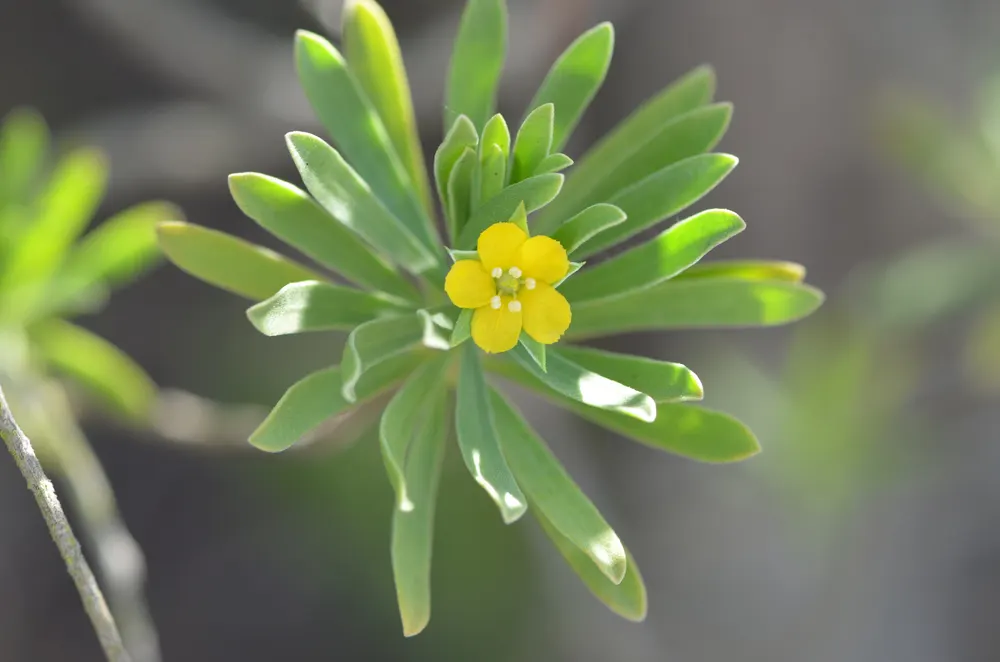
Photo: Bobyellow, CC BY-SA 4.0 (via Wikimedia Commons)
Bay Cedar
Suriana maritima
Also known as Bay Cedar, Rosemary Bush, Dog Almond, Tassel Plant
Key benefits
✦Traditional uses
✦Bay cedar has long been a fixture of shoreline life wherever warm tides meet sand, from the Florida Keys and the Caribbean to Pacific and Indian Ocean coastlines. Coastal communities have planted it for generations as a living windbreak and dune anchor, its tangled roots holding sand in place against storms and salt wind. In scattered folk traditions along some of these same coasts, the leaves have occasionally been crushed and applied to the skin as a soothing wash, though this practice is far less documented or standardized than its long-standing role as a hardy, protective shoreline plant. Its resilience, more than any tea or tincture, is what has earned it a place in coastal gardens and memory alike.
How to grow & use it
✦The full apothecary for Bay Cedar
Traditional remedies and step-by-step preparations, a complete growing guide, and how to harvest, dry, and store it, all unlocked with HerbLens Unlimited.
- ✦Remedies & preparations
- ✦ Growing guide
- ✦Harvest & storage
From under $6 a month. Free plant identifications always included.
- ✦Sea grape
- ✦Beach naupaka
- ✦Seaside goldenrod
- ✦Buttonwood
- ✦Bay bean
“For the plant that stands where land gives way to sea, holding the sand together one root at a time.”
Suriana maritima is the single species that gives its name to the entire plant family Surianaceae, and its seeds are so buoyant and salt-tolerant that ocean currents alone have scattered this one shrub across beaches on nearly every tropical coastline in the world.
Bay cedar has no documented history of medicinal use and no reliable safety data, so it should not be eaten or brewed; it is grown mainly as a coastal landscaping plant.