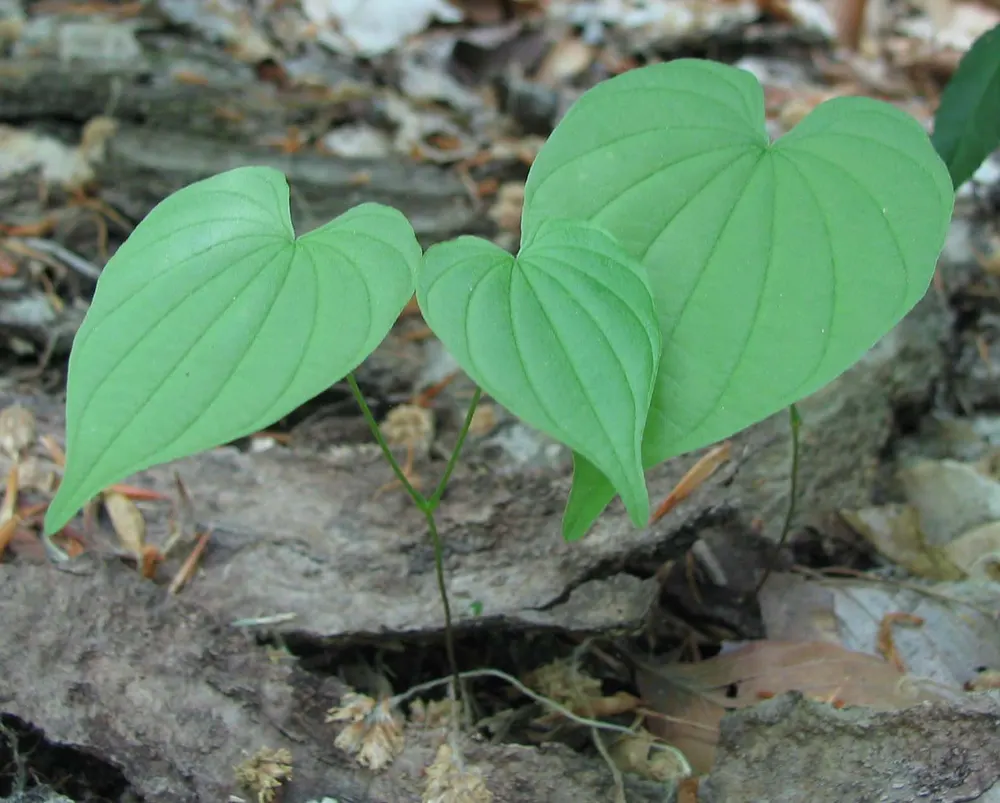
Photo: No machine-readable author provided. Phyzome assumed (based on copyright claims)., CC BY-SA 3.0 (via Wikimedia Commons)
Wild Yam
Dioscorea villosa
Also known as Colic Root, Rheumatism Root, China Root, Devil's Bones, Dioscorea paniculata
Key benefits
✦Traditional uses
✦Wild yam has long been called colic root and rheumatism root by American herbalists and Appalachian granny women, who steeped its knotty, twisting rhizome to ease cramping, griping bellies, and aching joints. Native communities and early physicians alike turned to it for what was once called female complaints, using it as a gentle antispasmodic for the womb. Its greatest fame came in the twentieth century, when chemist Russell Marker discovered a way to convert the diosgenin in wild yam root into synthetic progesterone, a breakthrough that helped launch the modern birth control pill and cortisone therapies. The root itself, though, holds no hormones your body can use, its traditional value lies in its long history as a calming, cramp-easing remedy rather than as a hormone source.
How to grow & use it
✦The full apothecary for Wild Yam
Traditional remedies and step-by-step preparations, a complete growing guide, and how to harvest, dry, and store it, all unlocked with HerbLens Unlimited.
- ✦Remedies & preparations
- ✦ Growing guide
- ✦Harvest & storage
From under $6 a month. Free plant identifications always included.
- ✦Cramp Bark
- ✦Ginger
- ✦Chamomile
- ✦Cramp Bark
- ✦Black Cohosh
“For the low, twisting ache of a cramping belly, when you want the old colic root that grandmothers reached for first.”
Wild yam's diosgenin was the very molecule Russell Marker used in 1943 to mass-produce synthetic progesterone from a truckload of Mexican yam roots, a discovery that made the birth control pill possible, even though the plant itself carries no hormones the body can absorb.
Wild yam root isn't eaten raw or in quantity; its saponins can cause nausea if overused. It contains no hormones the body can use directly, despite popular claims, so it isn't a substitute for hormone therapy, and it's best avoided in pregnancy or with hormone-sensitive conditions.