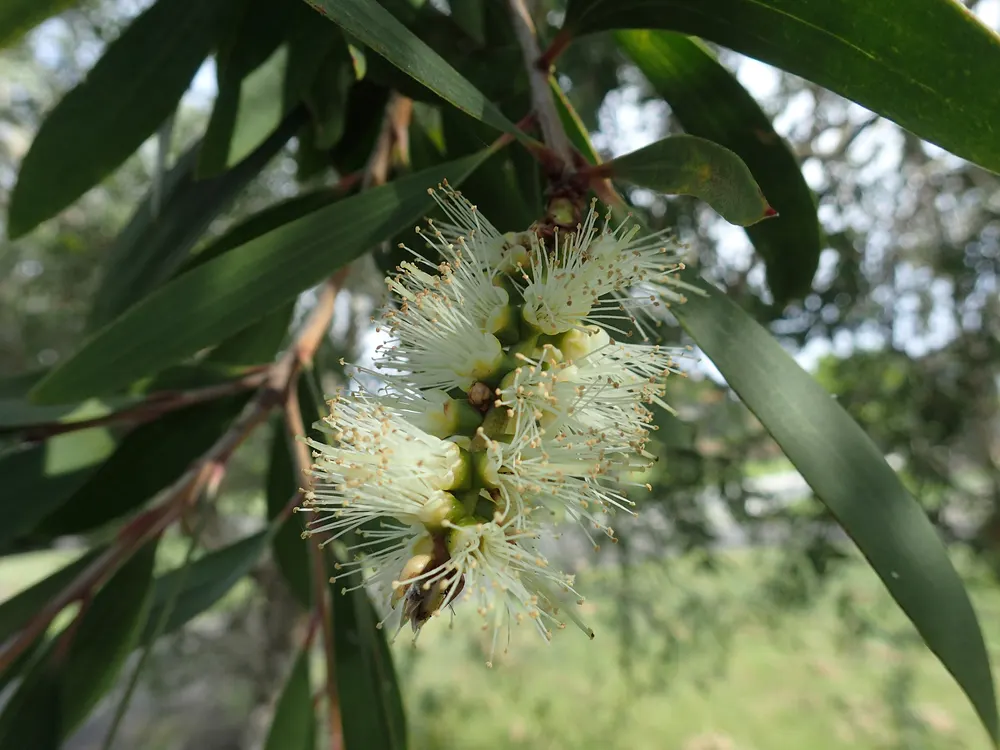
Photo: Geoff Derrin, CC BY-SA 4.0 (via Wikimedia Commons)
Broad-leaved Paperbark
Melaleuca quinquenervia
Also known as Niaouli, Punk Tree, Cajeput Tree, Five-Veined Paperbark
Key benefits
✦Traditional uses
✦Long before it had a Latin name, this paperbarked tree was already useful to the Aboriginal peoples of eastern Australia, who crushed its aromatic leaves and inhaled their sharp, camphor-like scent to clear a stuffy head, and peeled its soft, layered bark to wrap food for cooking over fire or to line simple shelters. When French settlers reached New Caledonia, they gave the tree the name niaouli and began distilling its leaves into an essential oil that traveled the world as a milder cousin of cajuput and tea tree oil, rubbed on the chest for colds or dabbed on cuts and insect bites. That dual legacy, bark for shelter and leaf for breath, still shapes how the tree is used today.
How to grow & use it
✦The full apothecary for Broad-leaved Paperbark
Traditional remedies and step-by-step preparations, a complete growing guide, and how to harvest, dry, and store it, all unlocked with HerbLens Unlimited.
- ✦Remedies & preparations
- ✦ Growing guide
- ✦Harvest & storage
From under $6 a month. Free plant identifications always included.
- ✦Tea Tree
- ✦Eucalyptus
- ✦Peppermint
- ✦Tea Tree
- ✦Cajuput
“When a stuffy chest longs for the clean, camphorous lift of an old apothecary remedy.”
The tree's thick, spongy bark peels away in dozens of papery layers, so many that early Australian settlers nicknamed it the punk tree, and it was this very bark that Aboriginal communities once used to wrap and steam food and to shingle bark huts.
Niaouli (broad-leaved paperbark) essential oil is for diluted topical use or inhalation only, never taken internally or applied undiluted, as it can irritate skin and mucous membranes. Keep it away from the eyes, infants, and pets, and avoid it if you are pregnant, nursing, or have asthma or epilepsy.