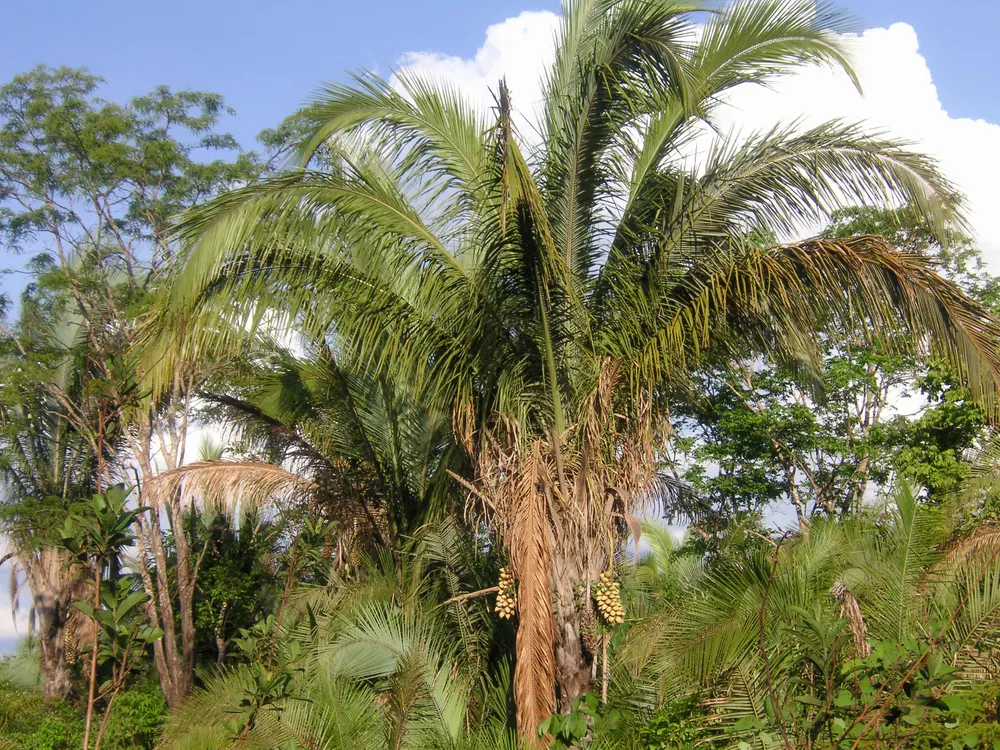
Photo: Nicolás Caballero Rau, CC BY-SA 2.0 de (via Wikimedia Commons)
Babassu Palm
Orbignya phalerata
Also known as Babaçu, Coco Babaçu, Cusi Palm, Attalea speciosa
Key benefits
✦Traditional uses
✦Long before babassu oil appeared on cosmetics shelves, it was already a household staple across northeastern Brazil, where entire communities grew up around the palm's hard-shelled fruit. For generations, women known as quebradeiras de coco, the coconut breakers, have cracked open babassu fruits by hand to extract the oil-rich kernels, using them for cooking, skin care, and household needs. The mesocarp, the fibrous flesh surrounding the seeds, has traditionally been used as a nourishing flour and, brewed into a mild decoction, has traditionally been used to ease digestive discomfort and calm inflammation. The oil itself, prized for its light texture, has traditionally been rubbed into dry skin and brittle hair to soften and restore them.
How to grow & use it
✦The full apothecary for Babassu Palm
Traditional remedies and step-by-step preparations, a complete growing guide, and how to harvest, dry, and store it, all unlocked with HerbLens Unlimited.
- ✦Remedies & preparations
- ✦ Growing guide
- ✦Harvest & storage
From under $6 a month. Free plant identifications always included.
- ✦Coconut
- ✦Andiroba
- ✦Copaiba
- ✦Coconut oil
- ✦Palm kernel oil
“For the patience of a forest gift that must be cracked open to be received.”
The babassu fruit's shell is so tough that harvesters traditionally crack it open with an axe blow aimed at a precise spot, a skill passed down through generations of quebradeiras de coco who can open thousands of fruits by hand in a single day.
Babassu kernel oil has long been used as a food and cosmetic oil, similar to coconut oil, with no significant toxicity reported. Anyone with palm or tree nut sensitivities should patch test before topical use, and traditional husk or mesocarp preparations aren't well studied for safety.