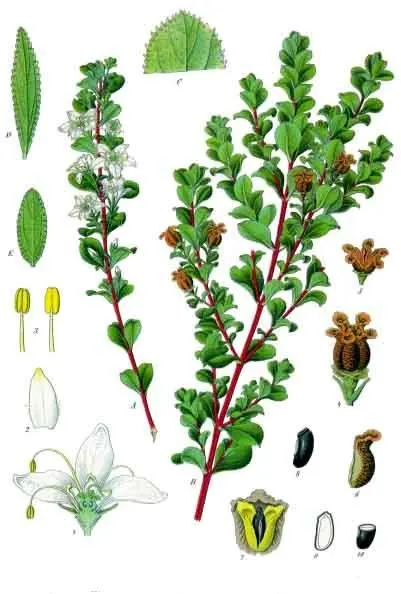
Photo: Franz Eugen Köhler, Köhler's Medizinal-Pflanzen, Public domain (via Wikimedia Commons)
Buchu
Agathosma betulina
Also known as Round-leaf Buchu, Bookoo, Bucco, Diosma betulina
Key benefits
✦Traditional uses
✦Long before it had a Latin name, buchu was medicine to the Khoikhoi people of the Cape, who dried and crushed the oil-rich leaves into a fragrant powder called buchu poeier, worn on the skin and taken to ease aches, digestive troubles, and complaints of the kidneys and bladder. When Dutch settlers arrived at the Cape in the 1600s, they adopted the plant quickly, steeping the leaves in brandy to make the famous buchu brandy, a household tonic kept in nearly every farmhouse cupboard for generations. The leaves carry a strong, resinous scent, part black currant, part mint, part rosemary, that made buchu as prized for its fragrance as for its traditional healing reputation. It remains one of South Africa's most iconic folk herbs, still sold in Cape markets much as it was two centuries ago.
How to grow & use it
✦The full apothecary for Buchu
Traditional remedies and step-by-step preparations, a complete growing guide, and how to harvest, dry, and store it, all unlocked with HerbLens Unlimited.
- ✦Remedies & preparations
- ✦ Growing guide
- ✦Harvest & storage
From under $6 a month. Free plant identifications always included.
- ✦Rooibos
- ✦Peppermint
- ✦Chamomile
- ✦Uva ursi
- ✦Juniper berry
“For an old Cape Colony remedy, aromatic and sharp, kept close for the mornings after a long day.”
Buchu leaves are dotted with tiny, visible oil glands, and crushing just one leaf releases a scent so strong, part black currant, part mint, that early Cape Dutch settlers named their signature tonic buchu brandy after it rather than after the fruit they steeped alongside it.
Buchu essential oil is concentrated and can be toxic to the liver if taken internally, so it should never be ingested. Buchu tea is a strong diuretic traditionally avoided during pregnancy and breastfeeding, and it may interact with diuretic medications or lithium.