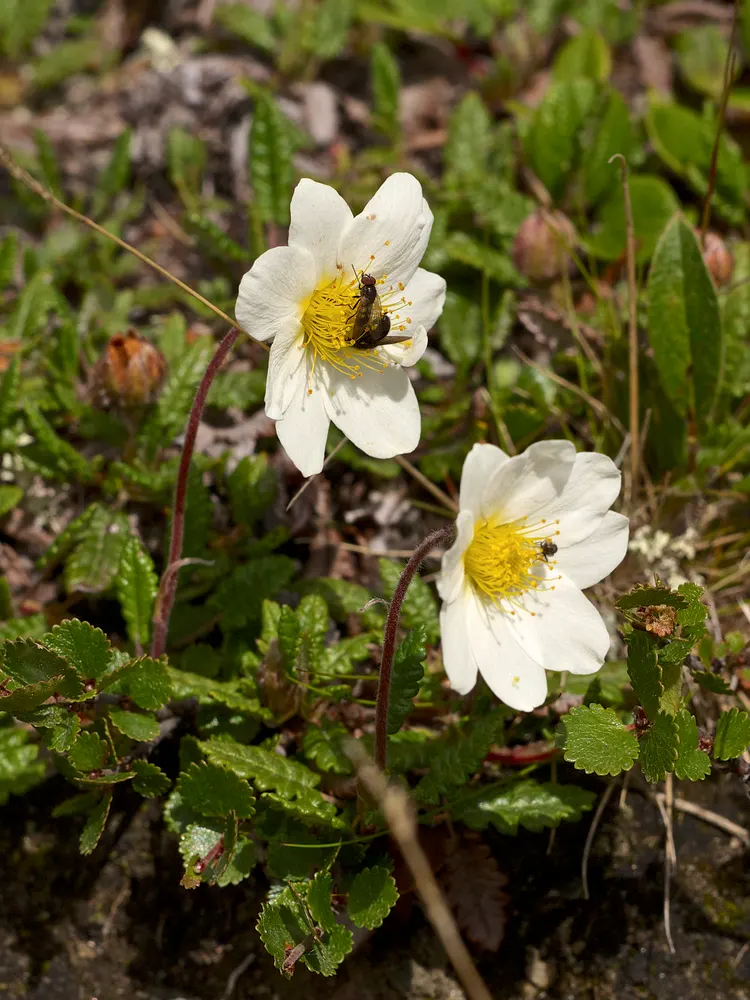
Photo: Jörg Hempel, CC BY-SA 3.0 de (via Wikimedia Commons)
Mountain Avens
Dryas octopetala
Also known as White Dryas, White Dryad, Eightpetal Mountain-avens, White Mountain Avens
Key benefits
✦Traditional uses
✦Long before it was a garden curiosity, mountain avens was a familiar plant to the peoples who lived alongside it across the Arctic and subarctic, from Inuit communities in the north to Sami herders in Scandinavia. Its low, leathery leaves were gathered and steeped into a mild tea used traditionally to settle the stomach after a heavy meal of meat or fish. The plant's sheer toughness, holding its evergreen leaves through brutal winters and blooming again the moment the snow retreats, made it a quiet emblem of endurance in places where little else could survive. Today it carries that honor formally: it is the territorial flower of Canada's Northwest Territories and the national flower of Iceland, where it is known as holtasóley.
How to grow & use it
✦The full apothecary for Mountain Avens
Traditional remedies and step-by-step preparations, a complete growing guide, and how to harvest, dry, and store it, all unlocked with HerbLens Unlimited.
- ✦Remedies & preparations
- ✦ Growing guide
- ✦Harvest & storage
From under $6 a month. Free plant identifications always included.
- ✦Wild mint
- ✦Rosehip
- ✦Labrador tea
- ✦Lady's mantle
- ✦Cinquefoil (Potentilla)
“For the quiet, sun-chasing resilience of the far northern tundra.”
The flowers of mountain avens gently track the sun across the sky, tilting their shallow, satellite-dish shape to follow it much like a sunflower. This turns each bloom into a small solar reflector, concentrating warmth at its center, which helps cold-numbed pollinators warm themselves and speeds the ripening of its seeds in the short Arctic summer.
No toxicity is documented for mountain avens, it just hasn't been closely studied, so treat it as a plant with a light traditional use rather than a proven remedy.