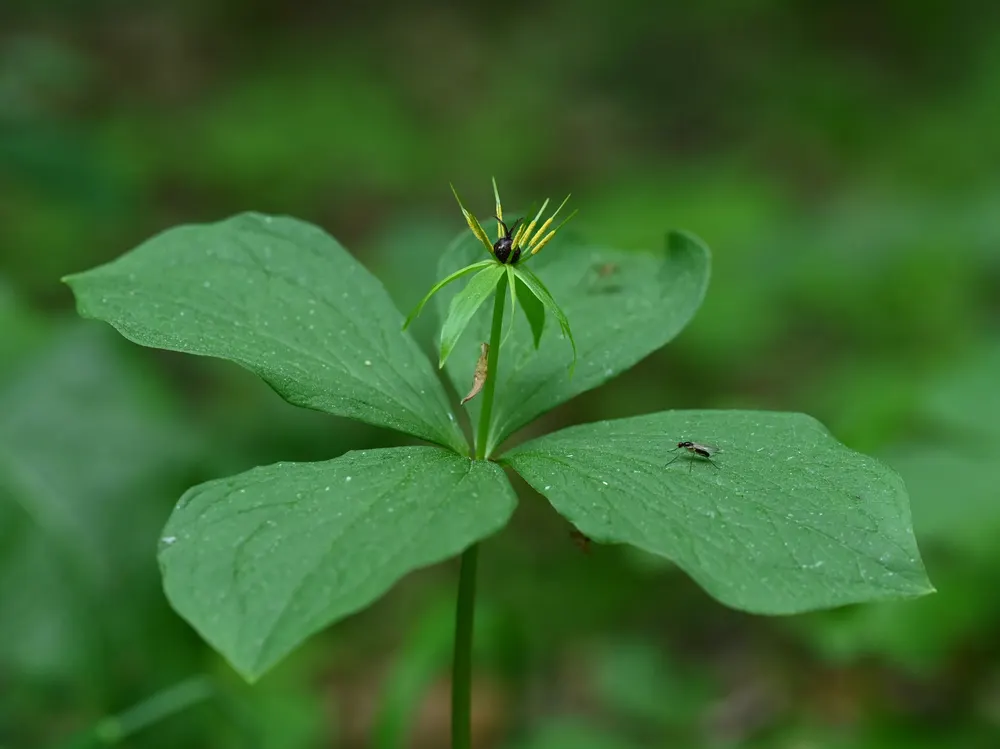
Photo: Krzysztof Ziarnek, Kenraiz, CC BY-SA 4.0 (via Wikimedia Commons)
Herb Paris
Paris quadrifolia
Also known as True Lover's Knot, One Berry, Four-Leaved Nightshade
Key benefits
✦Traditional uses
✦Herb Paris earned its old folk name, True Lover's Knot, from its unusually neat whorl of four leaves, a symmetry that medieval herbalists read as a sign of faithfulness and true love under the doctrine of signatures. Despite that romantic reputation, this is not a plant with a history of safe home use. Village folk medicine feared it as much as it prized it, since the shining black berry that follows the flower has long been recognized as dangerous, especially to children who mistake it for a bilberry. Its only documented therapeutic role was in classical European homeopathy, where practitioners prepared it as an extremely dilute tincture for complaints such as eye strain, headache, and nervous twitching, always far removed from the raw, poisonous plant itself.
How to grow & use it
✦The full apothecary for Herb Paris
Traditional remedies and step-by-step preparations, a complete growing guide, and how to harvest, dry, and store it, all unlocked with HerbLens Unlimited.
- ✦Remedies & preparations
- ✦ Growing guide
- ✦Harvest & storage
From under $6 a month. Free plant identifications always included.
- ✦Wood anemone
- ✦Trillium
- ✦Solomon's seal
- ✦Trillium species (a similarly shaped, non-toxic woodland ornamental)
- ✦Wood anemone
“For the hushed, shaded floor of an old wood, where four leaves cross like a compass point and a single dark berry keeps its watch, never to be picked.”
The species name quadrifolia refers to its almost perfectly symmetrical whorl of four leaves, a rare geometric precision that so struck medieval herbalists that they wove it into folklore about fidelity and true love, giving the plant its old English name, True Lover's Knot.
Herb Paris is poisonous and should never be eaten. Every part of the plant contains saponins, including paristyphnin and paridin, and the single blue-black berry is the most dangerous part, especially to children and pets who may mistake it for a bilberry or other wild fruit. Ingestion can cause nausea, vomiting, diarrhea, abdominal cramping, and dizziness, and larger amounts can affect the heart and nervous system. There is no safe traditional culinary or home-remedy use of this plant, and it should not be picked, brewed, or ingested in any form. Historically it was used only in professionally prepared, highly diluted homeopathic remedies, never as a crude herb. Pregnant or nursing women, young children, and pets should be kept well away from it wherever it grows. If any part of this plant is ever ingested, contact a poison control center or a qualified medical professional immediately rather than attempting any home treatment.