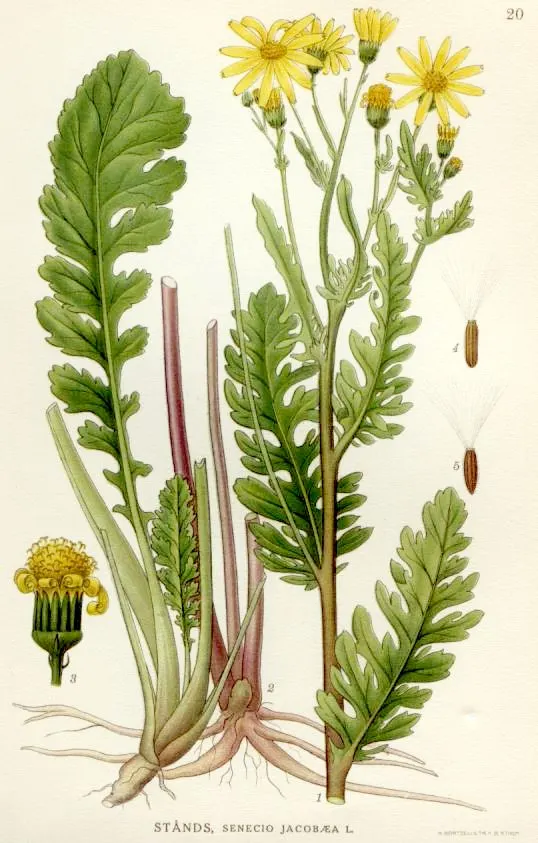
Photo: Carl Axel Magnus Lindman, Public domain (via Wikimedia Commons)
Ragwort
Jacobaea vulgaris
Also known as Common Ragwort, Tansy Ragwort, Stinking Willie, St. James Wort, Ragweed
Traditional uses
✦Ragwort has long been a familiar sight along hedgerows and grazing fields, its bright yellow flower heads once gathered by country folk for external poultices to ease bruises, sprains, and skin sores. Old herbals from the British Isles mention it under the name St. James Wort, tied to the saint's feast day when the plant comes into bloom. Despite this folk history, ragwort was never considered a plant to take internally, and farmers have feared it for centuries because livestock that graze on it can sicken and die. Its story in herbal tradition is really a caution more than a remedy, a plant admired for its color and pollinator value but respected from a distance.
How to grow & use it
✦The full apothecary for Ragwort
Traditional remedies and step-by-step preparations, a complete growing guide, and how to harvest, dry, and store it, all unlocked with HerbLens Unlimited.
- ✦Remedies & preparations
- ✦ Growing guide
- ✦Harvest & storage
From under $6 a month. Free plant identifications always included.
- ✦Calendula (Calendula officinalis) for a safe, traditional external skin poultice
- ✦Yarrow (Achillea millefolium) for traditional bruise and wound folk care
“A field of gold better admired from the footpath than gathered into the basket.”
Ragwort is the primary food plant for the cinnabar moth caterpillar, whose bold orange and black stripes advertise the same toxic alkaloids the plant carries, borrowed straight from its host into its own defense.
Jacobaea vulgaris (ragwort) is toxic and should never be ingested. Every part of the plant contains pyrrolizidine alkaloids that cause cumulative, irreversible liver damage in humans and animals, and there is no safe internal dose. It is a well-documented cause of fatal poisoning in horses, cattle, and other grazing livestock, and human poisonings have occurred from contaminated flour, honey, or herbal products mistakenly containing ragwort. Skin contact with the fresh plant has also been linked to contact dermatitis in sensitive individuals, so gloves are recommended when handling or removing it. This plant should not be confused with safer yellow-flowered look-alikes; if uncertain of an identification, do not touch or ingest any part of it. This entry is for identification and historical interest only, not a guide to use. If you have questions about a possible ragwort exposure or poisoning, contact a poison control center or qualified medical professional immediately.