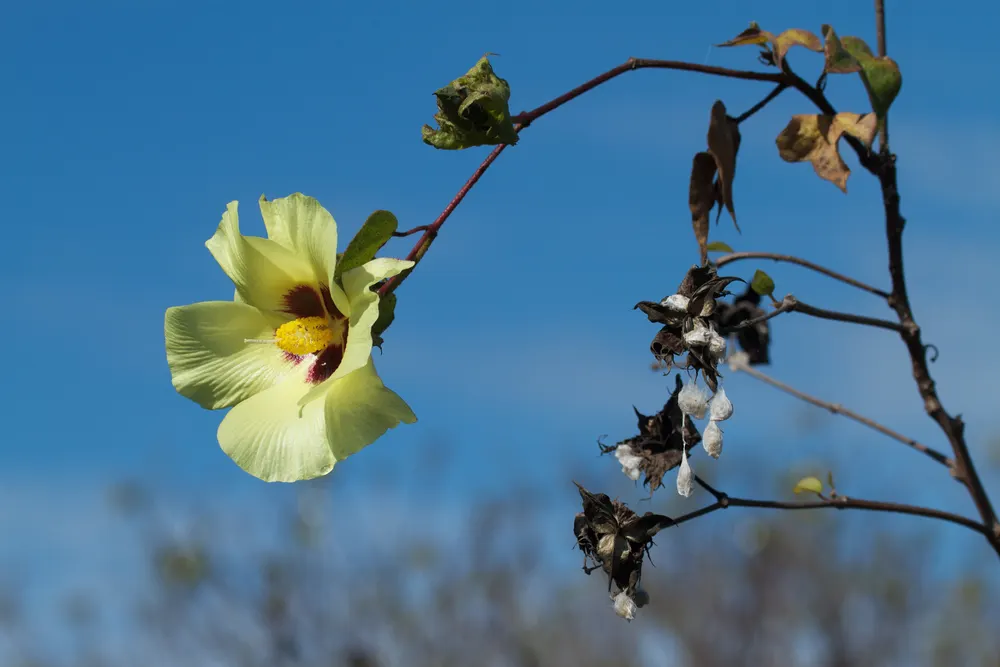
Photo: Brian Gratwicke, CC BY 2.0 (via Wikimedia Commons)
Pima Cotton
Gossypium barbadense
Also known as Extra-Long-Staple Cotton, Sea Island Cotton, Peruvian Cotton, Egyptian Cotton (related cultivars)
Key benefits
✦Traditional uses
✦Pima cotton belongs to a species first domesticated along the coast of Peru some 5,000 years ago, where early weavers discovered its unusually long, silky fibers made for cloth far finer than ordinary cotton. That same species later became famous as Sea Island cotton, grown along the coasts of Georgia and South Carolina, and its modern American strains take the name Pima from the Pima people of Arizona, who helped early 20th century growers develop and trial the crop. Beyond the fiber itself, the plant has a heavier, more complicated history in folk medicine, one that this entry treats with real caution rather than glossing over. Today, cottonseed oil is refined for cooking and cottonseed meal is fed to livestock, but the plant's raw parts carry risks that keep it out of home remedy use.
How to grow & use it
✦The full apothecary for Pima Cotton
Traditional remedies and step-by-step preparations, a complete growing guide, and how to harvest, dry, and store it, all unlocked with HerbLens Unlimited.
- ✦Remedies & preparations
- ✦ Growing guide
- ✦Harvest & storage
From under $6 a month. Free plant identifications always included.
- ✦Marigold (companion planting for pest deterrence)
- ✦Basil (companion planting)
- ✦Upland cotton, Gossypium hirsutum
- ✦Egyptian cotton cultivars of Gossypium barbadense
“When you want fiber so fine and long it feels closer to silk than cloth.”
Cottonseeds contain a natural compound called gossypol, and in the 1970s Chinese researchers studied it as a possible male contraceptive after noticing that villages using crude cottonseed oil for cooking saw a drop in births, but the compound turned out to be too toxic, causing dangerous potassium loss, for safe medical use.
Cotton is not a plant to self-medicate with, and this entry intentionally includes no home remedies. The root bark has a well-documented history as a folk abortifacient and emmenagogue, most notably used by enslaved women in the American South to try to end unwanted pregnancies, and it can cause uterine contractions; it should never be ingested, and this history is noted for context, not as a suggestion. Separately, raw cottonseed and unrefined cottonseed oil contain gossypol, a toxic compound linked to infertility, dangerous drops in blood potassium, and paralysis with repeated exposure, which is why cottonseed oil sold for cooking is always industrially refined to remove it. Pregnant or nursing individuals, and anyone considering any plant part for internal use, should avoid this plant entirely. As always, speak with a qualified healthcare professional before using any herb medicinally.