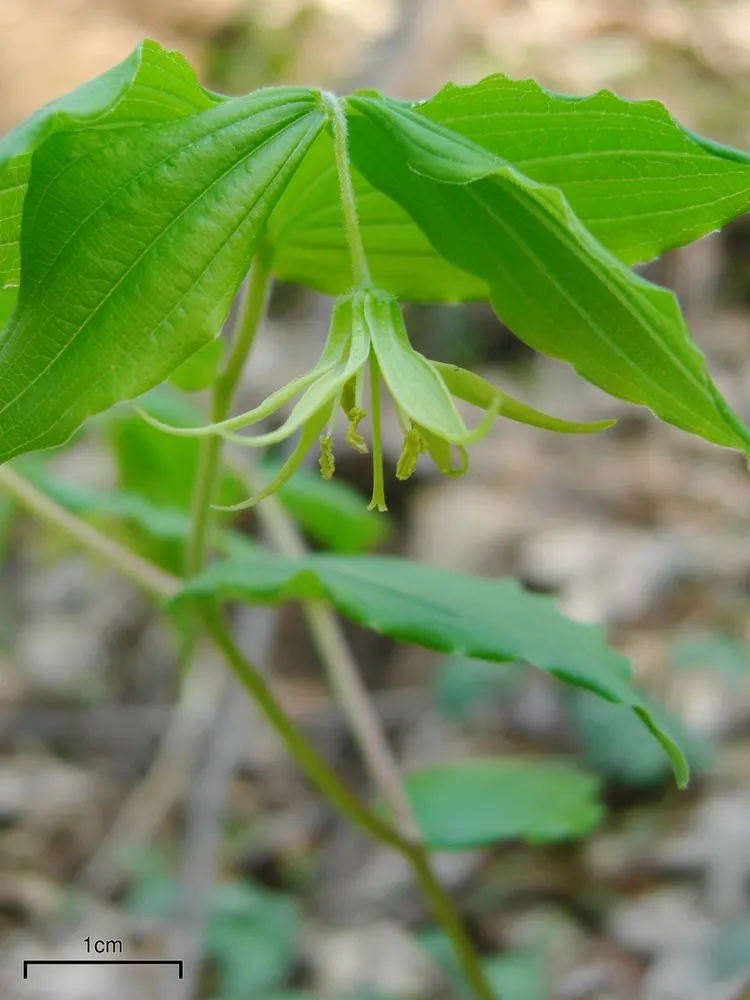
Photo: Jason Hollinger, CC BY 2.0 (via Wikimedia Commons)
Yellow Mandarin
Disporum lanuginosum
Also known as Yellow Fairybells, Nodding Mandarin, Hairy Disporum, Prosartes lanuginosa (botanical synonym)
Key benefits
✦Traditional uses
✦Yellow Mandarin has never held a place in the apothecary the way its more famous woodland cousins, Solomon's seal and Solomon's plume, once did. It grows quietly in the deep shade of old Appalachian coves, its soft, downy stems forking beneath pale yellow-green bells that nod toward the forest floor each spring. Naturalists and foragers have long prized it less for what it could treat and more for what its presence meant: a patch of Yellow Mandarin is often taken as a good sign of an undisturbed, mature woodland with rich, undamaged soil. Its story, so far, belongs more to the field guide than the medicine chest.
How to grow & use it
✦The full apothecary for Yellow Mandarin
Traditional remedies and step-by-step preparations, a complete growing guide, and how to harvest, dry, and store it, all unlocked with HerbLens Unlimited.
- ✦Remedies & preparations
- ✦ Growing guide
- ✦Harvest & storage
From under $6 a month. Free plant identifications always included.
- ✦Solomon's seal (Polygonatum biflorum)
- ✦Wild ginger (Asarum canadense)
- ✦Foamflower (Tiarella cordifolia)
- ✦Sessile-leaved bellwort (Uvularia sessilifolia)
- ✦Great Solomon's seal (Polygonatum biflorum) as a similar-textured woodland companion
“For the hush of an old, undisturbed woodland in spring, where pale yellow bells nod quietly beneath the new leaves overhead.”
The genus name Disporum comes from the Greek for "two seeds," a nod to the pair of ovules tucked into each chamber of its flower, while lanuginosum means "woolly," describing the fine, soft hairs that cover its young stems and leaves.
There's no established food or medicinal use for Yellow Mandarin, and it belongs to a plant family that also contains the highly toxic autumn crocus. Treat it as an ornamental woodland plant to look at, not to eat.