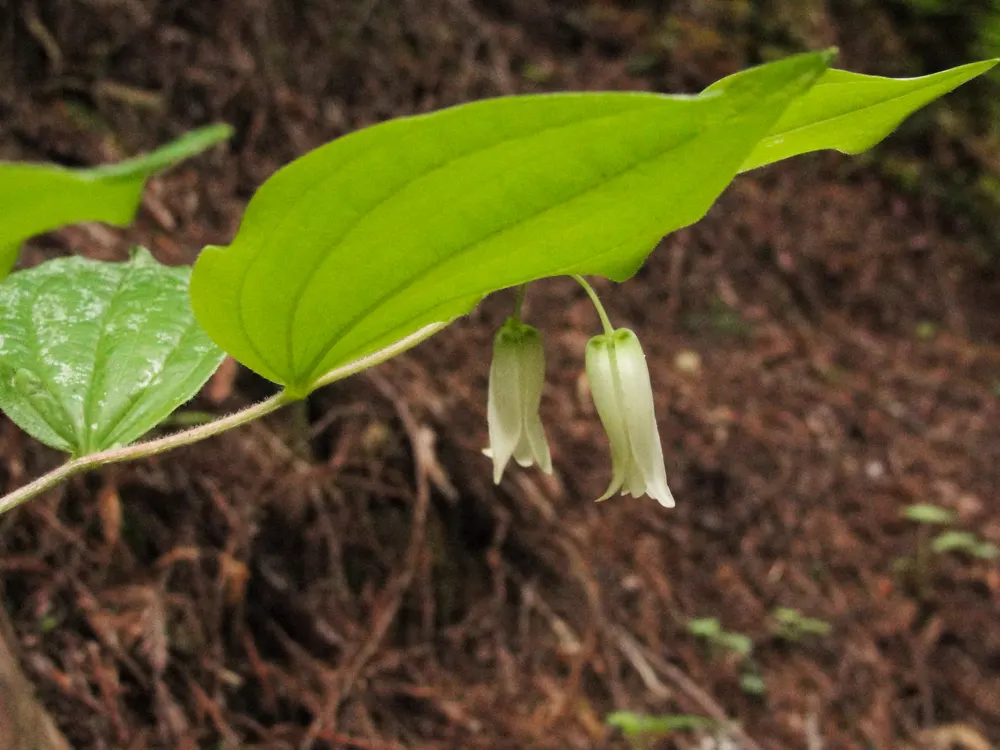
Photo: Miguel Vieira from Walnut Creek, CA, USA, CC BY 2.0 (via Wikimedia Commons)
Smith's Fairybells
Prosartes smithii
Also known as Smith's Fairybells, Large-flowered Fairybells, Fairy Bells
Key benefits
✦Traditional uses
✦Long before it had a Latin name, Smith's fairybells grew quietly in the deep shade of coastal Douglas-fir and redwood forests from British Columbia down into California, its bell-shaped flowers hidden beneath the leaves like something meant to be discovered rather than displayed. Indigenous peoples across its range would have come across the plant often while moving through these forests, and old regional accounts note that the mild berries of fairybells were sometimes nibbled along the trail, though they were never considered a significant food and were valued more as a small woodland curiosity than a staple. The plant's most notable legacy is actually a botanical one. For decades it was grouped with the Old World genus Disporum, until twentieth century genetic studies revealed the New World fairybells were distinct enough to earn a genus of their own. Today it endures mostly as a treasured native plant for shaded gardens, prized for the same quiet, unhurried elegance that must have caught the eye of foragers long ago.
How to grow & use it
✦The full apothecary for Smith's Fairybells
Traditional remedies and step-by-step preparations, a complete growing guide, and how to harvest, dry, and store it, all unlocked with HerbLens Unlimited.
- ✦Remedies & preparations
- ✦ Growing guide
- ✦Harvest & storage
From under $6 a month. Free plant identifications always included.
- ✦False Solomon's seal
- ✦Wild ginger
- ✦Western trillium
- ✦Hooker's fairybells (Prosartes hookeri)
- ✦Roughfruit fairybells (Prosartes trachycarpa)
“For the quiet corner of the garden where the light barely reaches, and something small and unhurried is exactly right.”
Smith's fairybells used to be classified in the Old World genus Disporum, but twentieth century botanists discovered that the New World fairybells were genetically distinct enough to deserve a genus of their own, so Prosartes was created just for these American woodland natives.
There's no reliable safety data for the berries or other parts of this plant, and unfamiliar wild berries are easy to misidentify, so it's best treated as a garden plant rather than a food.