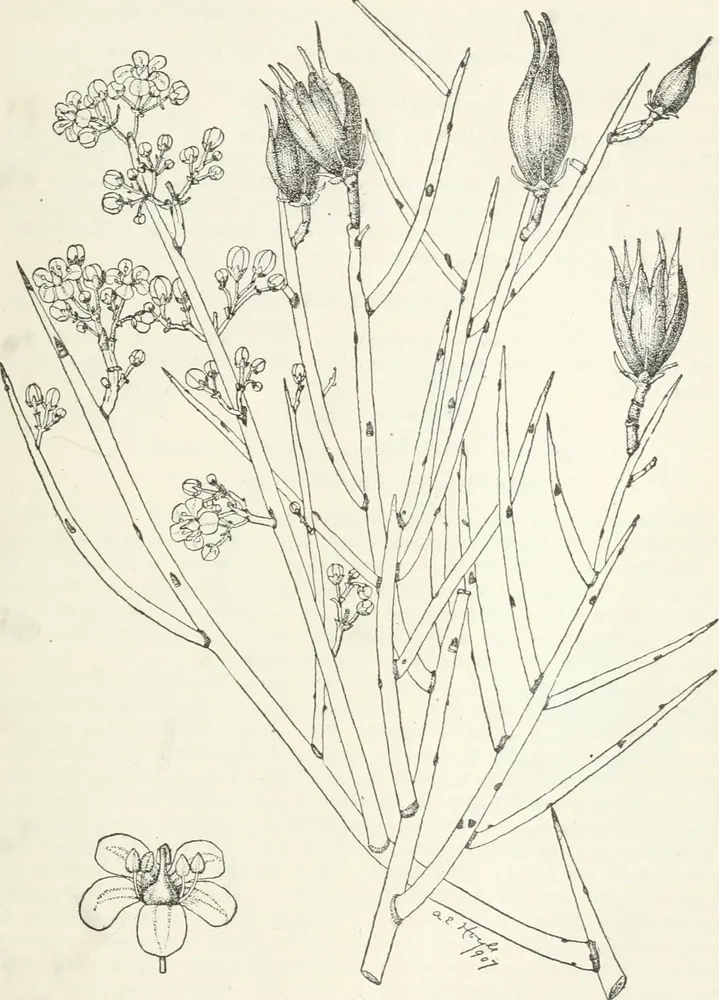
Photo: Internet Archive Book Images, No restrictions (via Wikimedia Commons)
Crucifixion Thorn
Canotia holacantha
Also known as Canotia, Crown of Thorns (desert), Arizona Crucifixion Thorn
Key benefits
✦Traditional uses
✦Canotia holacantha does not carry a documented history as a food, medicine, or tea plant, and no established herbal tradition has grown up around it the way it has for so many other desert natives. What it earned instead was a practical reputation among ranchers and homesteaders in the Arizona desert, who found that its dense, rigid thickets of green, nearly leafless spines were tough enough to pen livestock without a single post or rail, a kind of thorny corral grown straight out of the ground. Indigenous peoples of the region certainly knew this plant on sight long before ranchers arrived, but no widely recorded ethnobotanical use has survived into the written record. Today it is admired mostly for its sheer toughness, a green, spiny sentinel that asks almost nothing of the desert and still thrives.
How to grow & use it
✦The full apothecary for Crucifixion Thorn
Traditional remedies and step-by-step preparations, a complete growing guide, and how to harvest, dry, and store it, all unlocked with HerbLens Unlimited.
- ✦Remedies & preparations
- ✦ Growing guide
- ✦Harvest & storage
From under $6 a month. Free plant identifications always included.
“For the rugged corner of a desert garden that needs no coddling, only room to stand its ground.”
To survive its brutal desert home, Canotia holacantha mostly does without leaves, instead photosynthesizing through its own green stems and spines, a quiet trick for saving water that is easy to miss until you notice the plant is, in effect, all twig.
This plant has no known food or medicine use and should not be eaten. Its rigid spines are sharp enough to cause puncture wounds, so handle it with gloves.