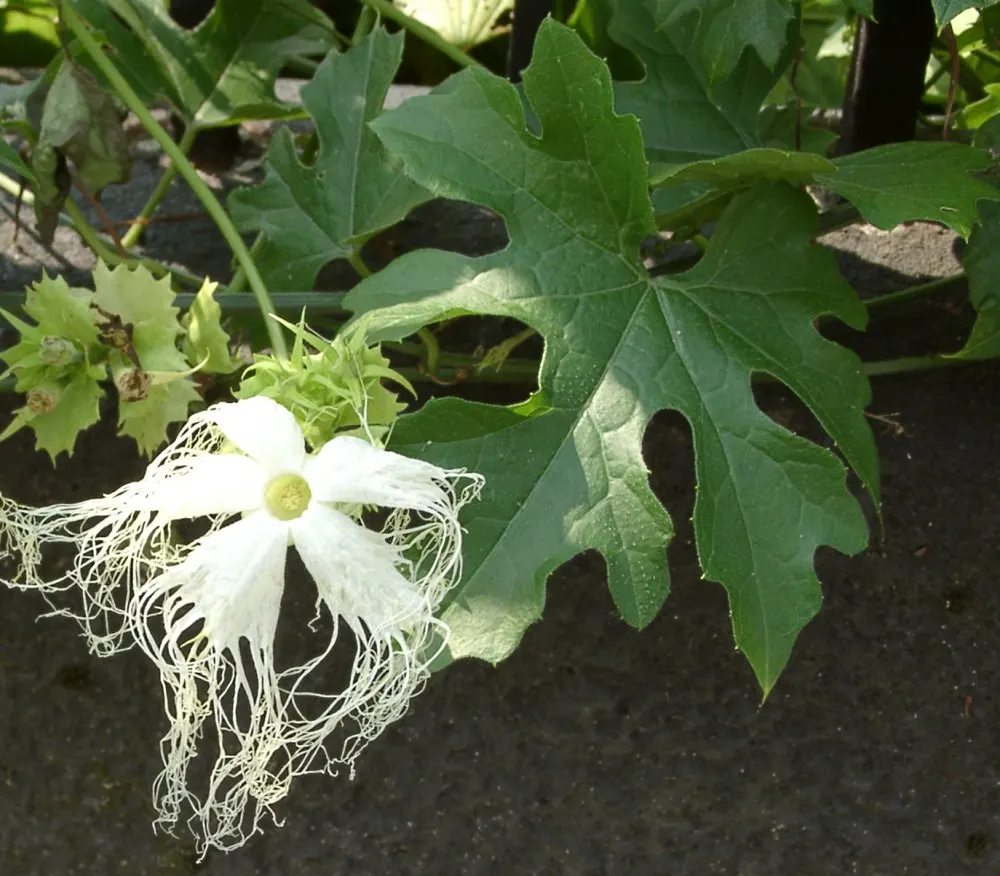
Photo: Michael Wolf, CC BY 2.5 (via Wikimedia Commons)
Chinese Cucumber
Trichosanthes kirilowii
Also known as Chinese Snake Gourd, Mongolian Snakegourd, Gua Lou (fruit), Tian Hua Fen (root), Trichosanthin vine
Key benefits
✦Traditional uses
✦In Traditional Chinese Medicine, the ripe fruit of this vine, known as Gua Lou, has long been dried and included in formulas meant to clear phlegm-heat and ease a tight, congested chest. The seeds were valued separately for their own gentle, moistening reputation in old herbal texts. The root, called Tian Hua Fen, held a very different and far more serious place in traditional practice, reserved for skilled hands because of its potency. This is a plant whose fruit and root traveled very separate paths in the old apothecary, one common and workaday, the other handled with real caution.
How to grow & use it
✦The full apothecary for Chinese Cucumber
Traditional remedies and step-by-step preparations, a complete growing guide, and how to harvest, dry, and store it, all unlocked with HerbLens Unlimited.
- ✦Remedies & preparations
- ✦ Growing guide
- ✦Harvest & storage
From under $6 a month. Free plant identifications always included.
- ✦Fritillaria bulb (Zhe Bei Mu)
- ✦Platycodon root
- ✦Poria mushroom
“A vine whose lace-white flowers open only after dark, and whose old reputation carries real weight.”
In the late 1980s, researchers isolated a protein from this plant's root, called trichosanthin, and studied it as an experimental antiviral compound nicknamed Compound Q, a striking example of how one old apothecary root found its way into modern virology labs.
The root of this plant (Tian Hua Fen) contains trichosanthin, a potent protein historically used as an abortifacient and to induce labor; it is unsafe in pregnancy and has caused severe allergic reactions and documented fatalities. This entry intentionally omits any home remedy or dosing information and should only ever be used under the guidance of a licensed TCM practitioner or physician.